Facebooker sentenced to two years in jail for abusing freedom, democracy rights

21:22 |
                                                        Quynh was arrested on April 13

A Facebook account owner in Hanoi was sentenced on October 27 to two years in prison for posting false information that affected businesses and harmed the stock market.


Dang Nhu Quynh, 42, was found guilty of “abusing the rights to freedom and democracy to violate interests of the State, rights and legitimate interests of organisations and individuals” under Article 331 of the Penal Code, by the People’s Court of Nam Tu Liem district.  


According to the indictment, since 2019, Quynh has used his personal Facebook account to post his own writings or share unverified information online. By April 2022, the account had over 300,000 followers.


On April 2, after learning that several business leaders in the finance and real estate sectors were arrested, Quynh posted that Do Anh Dung, chairman of property developer Tan Hoang Minh, has been dealt with by the law.


After authorities issued official announcements on the issue on April 5, Quynh edited his posts to make readers believe that he already knew that information.


He also posted information that Nguyen Van Tuan - Chairman of the Board of Directors cum General Director of Gelex Group JSC, who is also Chairman of the Board of Directors of Viglacera Corporation, has also been under investigation. On April 6, Quynh made two posts about the chairman, along with his pictures, claiming he will be arrested.


The posts went viral, and for the six subsequent days, the companies’ stocks were sold in large numbers, making their value plunge, causing panic among investors.


Quynh was arrested on April 13./.

Policy supporting people affected by COVID-19 reviewed

21:20 |
Most of the poor and near-poor households and other beneficiaries of social allowances, people affected by the pandemic, and those whose income has been sharply reduced have received support


The Ministry of Labour, Invalids and Social Affairs (MoLISA) has been tasked with coordinating with relevant ministries and agencies in collecting reports and recommendations of the Ministry of Planning and Investment (MoPI) related to evaluating the performance of the Government’s policy to support people affected by the COVID-19 pandemic.


According to the MoPI’s report, the implementation of the support policy under Resolution No. 42/NQ-CP has basically met requirements and principles set by the Government and the National Assembly Standing Committee.

Most of the poor and near-poor households and other beneficiaries of social allowances, people affected by the pandemic, and those whose income has been sharply reduced have received support.


The policy was implemented without recording phenomenon of advantage taking, wrong spending and relevant violations.


The Government’s COVID-19 policy has created a basis for localities to proactively and flexibly issue their own support policies.


The implementation of the resolution has helped State management agencies gain experience to better the development and implementation of support policies in order to deal with similar urgent situations in the future more effectively./.

Viet Nam is fastest growing digital economy in Southeast Asia

21:05 |

 Viet Nam tops the chart as the fastest growing digital economy and the fastest growing e-commerce sector in Southeast Asia, said Stephanie Davis, Vice President of Google Southeast Asia.

Fundamentals for Viet Nam's digital future remain solid, thanks to its high quality homegrown tech workforce and growing adoption of digital services across both urban and suburban areas, emphasized Stephanie Davis.

The growing awareness around environmental, social and governance considerations will help Viet Nam and Southeast Asia build a sustainable growth plan for the digital decade, Davis added.

According to a new report from Google, Temasek Holdings and Bain & Company, the Southeast Asian internet economy is set to reach US$200 billion in total value of transactions made this year, three years earlier than projected.

The six major economies covered in the report are: Indonesia, Malaysia, the Philippines, Singapore, Thailand, and Viet Nam.

Southeast Asia continues to see growth in the number of internet users-with 20 million new users added in 2022, raising the total number of users to 460 million, the report showed.

E-commerce continues to drive the growth in the region despite the resumption of offline shopping as pandemic lockdowns lifted. GMV in the sector grew 16 percent to US$131 billion in 2022.

Southeast Asia's online economy is still on track to reach US$1 trillion by 2030 as online shopping becomes the norm, the report noted.

Overall, the internet economy in the six countries is predicted to reach $330 billion by 2025 if companies put a greater focus on profitability for the next three years.


Information transparency a foundation for trust building

21:31 |
                                                                         Illustrative image

US-based Foreign Policy magazine has run an article highlighting the Vietnamese government has been “deeply transparent with the public during the COVID-19 crisis”.


The press and media in Vietnam have contributed to creating social consensus and building public trust to combat the pandemic, according to the article.


The comment on the role of the press and media in the Southeast Asian nation during the pandemic fight can be taken as a most vivid demonstration of the efforts to ensure freedom of speech and freedom of information in the country.

International media have repeatedly highlighted information transparency and clearness when they touch upon Vietnam’s keys in effectively containing pandemic outbreaks.


Many foreign officials and experts have also lauded the Vietnamese government’s effective utilisation of the high number of internet users who make up more than 70% of the national population to provide updates on the pandemic situation and instruct people to follow pandemic prevention and control measures.


In an article posted on the Asia Times, David Hutt, a freelance political journalist and analyst, wrote that the Communist Party of Vietnam has earned local and foreign plaudits for its firm COVID-19 containment measures.


Similarly, the live broadcast of the question-and-answer sessions and debates at the National Assembly over the country’s hot issues has received a strong support from voters nationwide.


This helps to further spread information and ensure that the legislature’s activities are more open, transparent and closer to voters and people, making it easier for them to supervise the NA’s performance.


Press agencies have also provided information in a timely, open and transparent way on the handling of senior officials who have violated regulations, and this has helped cement the public’s confidence in the Party and the State’s efforts in fighting corruption and other negative phenomena.


Yet, a number of organisations like the “Freedom House” and the Reporters Without Borders (RSF), together with some hostile forces, have always attempted to distort and criticise freedom of press and freedom of speech in Vietnam.

Last May, the organisations listed Vietnam in the group of countries without freedom of Internet and freedom of press. This was not the first year the Freedom House and the RSF had raised such subjective, one-sided and inaccurate comments on Vietnam.


Hostile forces appear to have deliberately ignored the fact that ensuring freedom of speech and freedom of press for all the citizens within the legal framework is Vietnam’s consistent policy.


The Vietnamese Party and State have always been respecting and guaranteeing human rights, including the right to freedom of speech of citizens.


The freedom was enshrined right in the first Constitution of the Democratic Republic of Vietnam in 1946 which said in its Article 10: “Vietnamese citizens have the rights to freedom of speech, freedom of publication, freedom of association and meeting, freedom of belief, freedom of residence and freedom of movement within the country, and can freely travel abroad and return home from abroad.”


The 2013 Constitution, in its Article 25, also affirms that the citizens shall enjoy the right to freedom of opinion and speech, freedom of press, freedom of access to information.


Along with the 2016 Press Law and the Law on Access to Information, the Vietnamese legal framework on the right to freedom of speech, freedom of press and freedom of access to information has been basically adequate and harmonious, matching international law on human rights.


Like other countries in the world, Vietnam has rolled out regulations to limit and prevent the acts of taking advantage of freedom of speech to infringe upon national interests, as well as legal rights and interests of organisations and citizens.


The 2018 Law on Cyber Security which officially came into force on January 1, 2019, proves Vietnam’s efforts in ensuring social safety and order on the cyber space, thus protecting people’s freedom of speech, freedom press and freedom of internet.


The Vietnamese press has always served as an effective, transparent and widespread social criticism and information channel of authorities of all levels and people of all social strata.

Apart from the task of popularising guidelines of the Party and policies and laws of the State, and providing information about all social activities for the people, the press has also served as a forum for the people to express their wishes and political viewpoints, participate in criticism, raise proposals regarding socio-economic, cultural, national defence-security policies, and engage in State and social management.


People can directly participate in law building, policy making and decision making on the country’s important matters by discussing, contributing their opinions and expressing their opinions and viewpoints on all aspects and fields through the press.


As of April 2022, Vietnam counted 816 press agencies, of which 115 newspapers and 116 magazines offered both print and electronic editions, 29 newspapers and magazines with online editions, and 72 agencies licensed to operate in both radio and television sectors. About 41,600 people were working in the press, of whom 17,161 had been granted with press cards for 2021-2025 as of August 15, 2021.


The figures reflect the strong development of the press in Vietnam over the past years.


Along with the IT development, the Internet and social networks have become a popular tool for every individual and organisation to express their viewpoints, spread information and exercise their freedom of speech.


The “Digital 2022: Vietnam” report conducted by We Are Social and Hootsuite shows that there were 72.1 million internet users in Vietnam in January 2022, accounting for 73.2% of the total population. Such social networks as Facebook, Zalo, Youtube, Instagram and Tiktok are dominant in the Southeast Asian nation.


The increase of 3.4 million Internet users in Vietnam between 2021 and 2022 reflects the expansion and noted development of the Internet use in the country.


Vietnam is now ranked the 12th worldwide and the 6th out of the 35 countries and territories in Asia in the number of internet users. The country has also accelerated the realisation of the target of “national digital transformation” towards each citizen having one smartphone and each household having one high-speed optical fibre Internet line.


These efforts by the Vietnamese government aim to promote the right to access the Internet for all. The Internet makes it easier for Vietnamese to access information by big news agencies worldwide like AFP, AP, Reuters, Kyodo, Economist, Financial Times, and New York Times.


Such figures also create a vivid picture of freedom of speech and freedom of press in Vietnam, which is an objective, undeniable, and irrefutable reality.


However, the Freedom House, the RSF and a number of hostile and reactionary organisations have regularly made groundless allegations about Vietnam's "suppression" of people’s freedom of speech, freedom of press and freedom of opinion.


The reality shows that Vietnamese law only punishes those who take advantage of the right to freedom and democracy, including freedom of Internet and speech, to conduct distortion, undermining and fraud acts, spread fake news and steal information, harming the interests of the Party, the community and individuals, and dividing the great national solidarity bloc.


Quite a few people have taken advantage of the freedom of speech and social networks to post many video clips with anti-Party and State contents, distort the internal political situation, defame the reputation of high-ranking leaders, incite demonstrations, cause disorder, and disturb security.


Their main maneuvers are to create and use social networks with servers based abroad to spread harmful information, especially on the occasions of important national political, economic, cultural and social events.


In 2021 alone, tens of thousands of pieces of such information online were prevented from spreading and removed.


Most recently, on October 9, competent authorities quickly handled the case where a personal Facebook account was used to post unverified information about depositors rushing to withdraw their money from banks, which caused public concerns and negatively affected the operations of banks as well as social security and order.


Vietnam’s enforcement of the Law on Cyber Security is intended to ensure a healthy cyber space for Internet users in the country. It is obvious that when raising comments on the freedom of Internet in Vietnam, the Freedom House, the RSF and hostile forces have deliberately turned a blind eye to the fact that not only Vietnam but also more than 180 countries worldwide have promulgated the cybersecurity law or legal regulations on cyber security as part of their codes to ensure national security.


Many countries such as the US, Germany, France, the Republic of Korea and Singapore have also issued provisions to strictly handle violations on the cyber space.


It can be seen that the annual reports or rankings by the Freedom House, the RSF and some other human rights organisations and hostile forces are always subjective, showing one-sided and prejudiced views, mainly based on information they gather from anti-government forces, not on the opinions of the Vietnamese people themselves. Such pieces of information have failed to reflect the reality of freedom of press and freedom of Internet in Vietnam.


The Vietnamese Party and State always respect and protect people's right to freedom of speech, freedom of press and freedom of Internet.


The stubborn deliberate distortion of the truth by the Freedom House, the RSF and some hostile forces lays bare a lack of goodwill towards Vietnam.


The vivid truth about the results that Vietnam has achieved in ensuring human rights, including freedom of press and freedom of Internet, is a steel-like answer./.

Vietnam supports visions to respond to global challenges, promote economic recovery

21:28 |
Ambassador Le Thi Tuyet Mai, Permanent Representative of Vietnam to the United Nations (UN), the World Trade Organisation and other international organisations in Geneva. 

Vietnam supports the implementation of visions and roadmaps outlined in the Bridgetown Covenant adopted at the 15th session of the UN Conference on Trade and Development (UNCTAD15) in October 2021 to help countries overcome inequality and vulnerability towards comprehensive and sustainable recovery after the COVID-19 pandemic, a Vietnamese diplomat has said. 


Ambassador Le Thi Tuyet Mai, Permanent Representative of Vietnam to the United Nations (UN), the World Trade Organisation and other international organisations in Geneva, made the comment at a high-level debate themed “Getting the global economy back on track and addressing the most pressing challenges” within the framework of the 72nd executive session of the UNCTAD in Geneva on October 20-21. 


At the meeting, the Vietnamese diplomat affirmed that Vietnam strongly supports the central role played by the UN, including UNCTAD, in global governance to address common global challenges.


She underlined the need for solutions and coordinated actions at the international, regional and national levels to address challenges and create conditions for inclusive and sustainable growth, saying that people should be put at the heart of development policies and strategies.


The support of development partners is needed to come up with innovative solutions and actions in order to secure resources and finance from all sources to increase support for low-income countries, especially under-developed country, in addressing global issues to promote trade and inclusive and sustainable development, she said.


Mai also shared Vietnam’s achievements in controlling the COVID-19 pandemic and implementing the socio-economic development and recovery programme, saying that Vietnam is transforming its economic model towards a digital economy, innovation, green and sustainable growth, and harmony between economic development, environmental protection and social welfare for the people. 


As one of the most vulnerable countries to negative impacts of climate change, Vietnam continues to participate in climate change adaptation initiatives and commitments such as the goal of becoming carbon neutral by 2050, Mai stressed, adding that Vietnam expects to receive support from the UN agencies and other partners in promoting green finance and the Just Energy Transition Partnership (JETP) initiative. 


At the event, delegates shared their optimism about the multilateral system, saying that addressing a series of crises facing the world and moving the global economy on the right track require greater will and actions.


UN Deputy Secretary-General Amina Mohammed called for increased liquidity for developing countries to help them cope with inflation, public debts and climate change./. 

Vietnam enhances intellectual property enforcement in cultural, creative sectors

21:26 |
                                                                    Illustrative image

The enforcement of intellectual property in the fields of culture and creativity in Vietnam was the focus of a seminar held on October 24  in Hanoi by the Vietnam National Institute for Culture and Arts Studies (VICAS), Copyright Office under the Ministry of Culture, Sports and Tourism, Xuong thu Bay (The 7th Atelier) and Hanoi Grapevine.


The event offered a chance for scientists, managers, businesses, organisations and individuals to exchange on the issue, giving suggestions to improve institutional capacity in intellectual property protection for the cultural and creative sectors. It also sought to raise awareness for those engaged in these fields.


According to organisers, the cultural and creative sectors contributed more than 8 billion USD to the national economy, accounting for 3.61% of the total Gross Domestic Product in 2018, while creating jobs for over 3 million people.


Vietnam’s young dynamic population offers plenty of opportunities to grow a flourishing market for cultural and creative products and services. However, the emerging cultural and creative sectors in Vietnam are facing rampant infringements, which threaten the intellectual property rights of artists and creators and undermine the development of a healthy creative economy.


Results of studies conducted by experts of the “Strengthening Intellectual Property Enforcement in Vietnam” project launched by VICAS and the British Council were also announced at the seminar.


This project is made possible with the support of the United Nations Educational, Scientific and Cultural Organization (UNESCO)’s International Fund for Cultural Diversity (IFCD), within the framework of the UNESCO 2005 Convention on the Protection and Promotion of the Diversity of Cultural Expressions.


Implemented between March 2022 and March 2023, the project will engage closely with government departments and offices working in the area of intellectual property in arts and culture, as well as artists and creative practitioners. It aims to improve understanding and practice surrounding intellectual property protection in the cultural and creative sectors through workshops for artists and creators./.

Vietnam commits to advancing women’s progress

19:34 |


Ambassador Nguyen Phuong Tra, Charge d'affaires a.i. of Vietnam to the UN, highlighted Vietnam’s commitments to promoting women’s advancement while addressing an open debate of the UN Security Council on October 20.

The commitment has its root in women's role and great contributions to Vietnam's history of struggling for national independence and development, Tra told the debate, themed “Strengthening Women's Resilience and Leadership as a Path to Peace in Regions Plagued by Armed Groups.”  

She said Vietnam has sent female officers to UN peacekeeping missions and wishes that women will have more favourable conditions to contribute to UN peacekeeping operations, adding that Vietnam has made active contributions to the UN agenda on women, peace and security, especially in its capacity as non-permanent member of the Security Council.

She proposed intensifying women’s participation in peace negotiations and building and exchanging experience in this field, saying countries should work to ensure and promote women’s full, equal and meaningful participation at different levels by integrating their rights into national policy frameworks.

Vietnam is committed to contributing international efforts in promoting the agenda on women, peace and security, the diplomat affirmed.

The participating countries shared the view that strong political commitments and pragmatic actions are needed to improve women’s power and ensure their rights as well as their full and equal participation in all aspects of social life, especially in preventing conflicts and building peace.

The Security Council adopted resolution (S/RES/1325) on women and peace and security on October 31, 2000. It is the first legal document of the council that requires parties in conflicts to prevent violations of women's rights and supports women's involvement in peace talks and post-conflict reconstruction./.

Human rights to be brought into national education

21:55 |

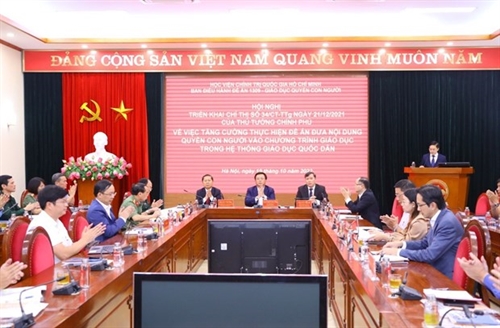
 A national conference was held on October 19 to deploy the Prime Minister’s decree on intensifying the implementation of a project on including human rights in the national education system.

 
The event was held in both virtual and in-person formats under the chair of Nguyen Xuan Thang, Politburo member, President of the Ho Chi Minh National Academy of Politics (HCMA), and Chairman of the Central Theory Council.


Addressing the event, Thang stressed the importance of the implementation of the decree after the Party Central Committee’s sixth session approved a resolution on continuing to build and perfect a law-governed socialist state of Vietnam, in which the principle of respecting, ensuring and protecting human rights has been highlighted as a key aspect.
 
In addition, Vietnam was honored and proud to be elected to the United Nations Human Rights Council for the 2023-25 tenure, he noted.
 
Emphasizing that under the project, 100 percent of institutions in the national education system are expected to teach human rights by the end of 2025, so the official said there is not much time left and the workload remains large.
 
He urged agencies, localities, educational associations, sectors and the political system to make concerted efforts to implement the decree and build programs and plans to fulfill their tasks.

Strengthening response to cyberinformation security incidents

20:54 |


The Prime Minister has issued Directive No. 18/CT-TTg dated October 13, 2022 on stepping-up response to cyberinformation security incidents in Viet Nam.

Prime Minister directs to step up response to Vietnamese cyber information security incidents - Ảnh 1.

Illustration photo

Cyberinformation security is vital in protecting the country's successful development in the digital era. Responding to cyberinformation security incidents is crucial to help agencies and organizations minimize damage, even when serious incidents occur.

To enhance the effectiveness of network incident response operations, the Prime Minister directs ministries, ministerial-level agencies, provincial/municipal People's Committees, state corporations and organizations to implement the following contents:

First, they must employ active approach in responding to cyberinformation security incidents, including:

Actively search for threats and scan for vulnerabilities in information systems within the scope of management at least once every six months; Issue emergency response plans and scenarios for the information system before December 31, 2022, and promptly update when there are changes; Organize combat drills at least once a year for information systems at level 3 or higher to promptly assess the ability to prevent intrusion and detect weaknesses in processes, technology and people. In the case of detecting weaknesses, security holes that allow penetration and control of the system, simultaneously remediate weaknesses and vulnerabilities, and hunt for threats.

Second, the Ministry of Information and Communications must develop Incident Response Teams for 11 important areas prioritized to ensure cyberinformation security according to Decision No. 632/QD-TTg dated May 10, 2017, of the Prime Minister; build the Team's capacity framework by November 30, 2022.

Third, enterprises providing telecommunications and Internet services shall publish contact information for handling incident notices on the portal before October 31, 2022; educate customers on how to report network information insecurity incidents./.


World Food Day 2022

16:02 |

 In this year alone, the global impact of compounding crises demonstrates, more than ever, why food scarcity must be addressed internationally and how there must be a shift in the food and agricultural systems.

October 16 is World Food Day, and this year it seems crucial to take stock of the causes and consequences of global food insecurity. Food insecurity has already been of greater concern in recent years due to the global COVID-19 pandemic disrupting our interconnected governance, trade, welfare, and humanitarian aid systems. This year has seen a continuation of those disruptions exacerbated by the ongoing pandemic and increasing challenges brought on by climate and environment-induced disasters, conflict, and rising prices.

The impact could not be more obvious. Findings from the UN Food and Agriculture Organization (FAO) show that over 40% of the world population – or 3.1 billion people – cannot afford a healthy diet and that 828 million people are hungry. Rising food prices across crops in meats, cereals, and oils have disrupted the Food Price Index, which has been declining for six months.

The increase in food insecurity and its impact on global hunger has been observed worldwide. But between certain regions, there are clear disparities. Africa has been bearing the greater burden of food insecurity. A new report from the FAO reveals that in 2021, 20.2 percent, or one-fifth of the total population, went hungry. The next highest rate is Asia, with 9.1 percent. A disparity that wide should be more than enough to raise the alarm.

This food insecurity has also resulted in micronutrient deficiencies, such as zinc, iron, vitamin A, vitamin B, folate, and vitamin D. While at first unnoticeable; these deficiencies can lead to long-term losses in health and cognitive development. This would be fatal, especially to young children still developing and still needing proper nutrition.

Researchers from the Global Alliance for Improved Nutrition (GAIN) conducted an analysis of the global prevalence of micronutrient deficiencies in preschool-aged children and non-pregnant women of reproductive age. Its findings suggested that over half of the preschoolers and two-thirds of the women in the study reported a deficiency in either iron, zinc, or folate. Regionally, the majority of the children and women lived in east Asia and the Pacific, south Asia, or sub-Saharan Africa. While the report acknowledged its limitations, and in how rarely the rate of deficiency is quantified and the absence of a global standard rate at the time of the study, as GAIN Executive Director Dr Lawrence Haddad has noted, one might observe the troubling implications for a wider demographic.

“Once we factor in males and other age groups, such as schoolchildren and the elderly, these numbers imply that our current global suggestion that two billion people suffer from hidden hunger is a gross underestimation,” he said.

In the context of Africa and the Sahel region, local governments’ capacity to respond to the food crisis have been limited or difficult to implement in the face of conflict within the region and in neighboring countries. Even international intervention from groups like FAO and World Food Programme (WFP) have had to work with limited resources and funding. In February, it was reported that within the last three years in the Sahel, the number of people dealing with starvation increased dramatically and dangerously, from 3.6 to 10.5 million.

Forced displacement caused by conflict in the region also impacts food security, as more than 5 million people live in forced displacement from Burkina Faso to the Lake Chad Basin area.

But what is perhaps more pressing, and more devastating, is the impact of climate change or environment-induced disasters on food security. The Sahel region in particular is susceptible to extreme weather conditions such as heavy rains and floods, and the Horn of Africa is suffering from a historic drought this year. Looking at other regions, the recent floods that devastated Pakistan destroyed over $70 billion USD worth in rice crops. This has also led to a rise in rice prices in the international market from other major rice exporters such as India, Thailand, and Viet Nam. Meanwhile, sub-Saharan Africa is heavily dependent on rice imports. It is an example of how connected the world is, and how we are dependent on each other to help meet that most basic and essential need: food.

With all these crises piling onto one another, it is easy to feel overwhelmed. But it also makes the theme of World Food Day even more pertinent. It is why this year’s theme feels more like a call to action: leave no one behind. These challenges will persist and only further overwhelm the global community unless we are united in our efforts to mitigate food insecurity. We are undeniably and inextricably dependent on each other to meet our needs for food, health, and security. “Leave no one behind” is a simplified reminder and approach, to a problem with complex parts and overlapping problems.

This call to action will only ring true when greater systematic changes are implemented in the food systems, and when this is revisited frequently rather than left for the next big natural disaster.

Được tạo bởi Blogger.