Reactionary portraits: Bui Thanh Hieu - from a criminal to a political psycho

11:26 |

These recent days, especially on Monday after the authority suspended news website PetroTimes for three months, due to its’ violation of press regulations. The ministry of information and communication said the suspension had been proposed by the site’s owner, the Vietnam Petroleum Association. After three months, the ministry will review the case and decide if the site, which covers a wide range of topics, can be relaunched.
The ministry on Monday also decided to revoke the press card of PetroTimes’ editor-in-chief Nguyen Nhu Phong, who had already been sacked by the site’s owner.
 In this incident, people happened to hear about Bui Thanh Hieu (Bùi Thanh Hiếu in Vietnamese), a blogger also known as Nguoi Buon Gio (Wind Trader). So who is Bui Thanh Hieu? And how did he get involved in the PetroTimes suspension. This article would like to help you understand more about this case.
Bui Thanh Hieu was born in 1972,  originated from Hung Yen province but lived in Hanoi. His father and his younger brother were addicted to drugs, his older sister had record of being arrested for organizing prostitution in 2008 and released in 2011. Hieu got more lucks than his relatives, he married a wife who worked for Techcombank and gave birth to a good-looking boy for him.
His life in Vietnam was not quite smooth. After graduated from the high school, he went on military service in 1990 and returned in 1992. At home, he got no job and helped his mother to sell sidewalk drinks. He used to learn to be a carpenter, but soon he was found out to a drug addict. In 1994, Hieu was arrested and sentenced to years in prison for stocking and using drugs. Due to the State’s pardon policies, Hieu was released in 1997 and lived at Hoan Kiem district. But “old habits die hard”, once again Hieu was held custody for extorting and stocking illegal weapons. As that, it can be seen Hieu had a long time of being attached to drugs and laws violations, a dyed-in-the-wool criminal.
But not just that, after running out of ways to get money for drugs, Hieu started to write blogs on the Internet. At first, like many, he wrote to cry out for his life and blame for his bad lucks. For times, he encountered with extreme posts and information from hostile forces at home and abroad, Hieu began his path of becoming a political psycho. He got some fame after taking part to protests and posting against China on the South China Sea disputes. In these blog posts, he distorted and groundlessly criticized the Party and State of Vietnam for what he claimed to selling soil to China. While the Party and State have done everything possible to protect the country’s sovereignty, these individuals like him who have no knowledge about the real situation but have conducted many activities hurting the country’s interests and making situation more complicated in the name of patriotism.
 Morever, Hieu’s political psychopath exaggerated since he got contact with Viet Tan, a terrorist group, and its members, whom he may find more the same like him. With Viet Tan’s supports, Hieu left Vietnam and now lived exiled in Germany. There he finished Speaking in Silence which groundlessly accused the Vietnam’s authorities of restricting freedom of press and expression. Being incited and encouraged by these anti-State aggressive elements, Hieu became “Wind Trader” as we know. Why is “wind”? Maybe, because what he writes and says are so absurd and reasonless as winds. They are just like funny stories for leisure. Those go by and fall into oblivion as no one would believe. His blog posts just like “gone with the wind” as his pen-name, “wind trader”. Hieu also called for an international campaign for Dieu Cay, another psycho blogger like him, who arrested and charged for violating the Vietnam’s laws.
It’s a ironical that hostile forces and human rights organizations, for various purposes, raised him as a journalist fighting for press freedom and have even nominated him for human rights prizes like Hellman/Hammett in 2010 and so on, which even make him more psycho. His paranoia has gone much further recently. In the Yen Bai shooting incident in August, he absurdly imagined that offender Do Cuong Minh did not commit suicide but was killed by General Secretary Nguyen Phu Trong. A paranoia even an imginative person would not think of. All that concretely prove a political psycho Hieu is.
Back to the case of PetroTimes, it’s not sure on purpose or not the website and its editor-in-chief Nguyen Nhu Phong posted the interview of Bui Thanh Hieu held by Thoibao.de, an online newspaper of German Vietnamese in Berlin. In the interview, as usual Hieu expressed his political psycho nature about Trinh Xuan Thanh incident, an internal affair of the Vietnam’s State, through his paranoia, Hieu suggested that this is a civil power conflict inside the Communist Party of Vietnam (CPV) and criticized the Party and State of Vietnam for abusing power. What a quite political psycho! 
It’s all known that Trinh Xuan Thanh is a corrupted official, who have been sacked and expelled from the CPV, and now wanted by the Vietnam police and Interpol. Hieu not just ignored that but also showed favor of Trinh Xuan Thanh as an accessory. It’s not clear why PetroTimes posted this interview on its website, and what were other faults of this e-newspaper that led to its’ suspension, everything is still under investigation. But, the move of posting an interview of a political psycho, that is known for his anti-State activities and links to terrorist groups Viet Tan like Bui Thanh Hieu, is a big mistake of the PetroTimes. What a pity for a e-newspaper which often published a lot of positive articles. It is a helpful lesson for other newspapers to step away from the PetroTimes’ mistake and recognize the true nature of a political psycho of “Wind Trader” Bui Thanh Hieu./.

Identifying strategic partnership in globalization and international integration era (Part 2 and end)

14:09 |

Kết quả hình ảnh cho strategic partnership

Several typical types of strategic partnership worldwide
According to experts in international studies, due to the multilateralization and diversification in international relations, together with types of common strategic partnerships, such as strategic partnership, comprehensive strategic partnership, selective strategic partnership, there appear a number of specific strategic partnerships which should be exactly analyzed and indentified in reality.
1. Impacted by increasingly deepened and broadened globalization and international integration, one country could establish strategic partnership with several other countries to form “special strategic partners” so as to pursue special national interests. For instance, Russia - India relationship and Vietnam - Russia relationship are all identified as special strategic partnerships or strategic partnerships of special nature.
2. Strategic partnership does not exclude the alliance or the relationship among allies. Typically when the two-pillar world order collapsed, the former socialist countries seemed to hesitate to mention the matter of “military alliance” or “ally”, only the U.S. and European countries continued to maintain such relationships, i.e. the North Atlantic Treaty Organization (NATO), the military alliances between the U.S. and Japan, the U.S. and South Korea. Therefore, countries could include “military alliance” in “strategic partnership”. Which means they do not need to sign a military alliance treaty to avoid confrontation but possibly highlight special nature of the relationship.
3. In the modern world, the forming conditions and the interdependence among states in international relations are increasing. Thus, a country, no matter how great its potential, strength,  natural resources, and development level are, is influenced by its interdependent and complex relations with other countries. Similarly, no countries (no matter how great their economic, military strength is) are able to independently resolve global pressing issues but to rely on a close international cooperation. Under that condition, every country should adapt itself quickly to the new international environment by combining the former approaches with the new ones to key matters in international relations. Hence, the signing of various strategic partnerships, including extensive, connective strategic partnerships among countries, contributes to forming a new world order which might be called “multi-partner world order” or “network world order”.

However, people also believe that in addition to strategic partnerships that encourage the development of each country, region and the world, there remain a number of strategic partnerships being used by several countries to make their partners dependent to compete for geopolitical and geostrategic benefits. Therefore, the identification of strategic partnership among countries is a matter of paramount importance drawing a lot of interest from many countries in the world.

Identifying strategic partnership in globalization and international integration era (Part 1)

14:06 |

Kết quả hình ảnh cho Identifying strategic partnership in globalization and international integration era

Formation and development of strategic partnership
The idea of strategic partnership among countries was initiated right in the “Cold War” time. However, it was just mentioned in studies on special cooperation among countries, not a systematic theory. Until the end of the 1980s, in a world of changes, scholars used the notion of strategic partnership more to analyze relationships among countries in the aspects of geopolitics, national interests; forms, contents, aims and consequences of those relationships. By the end of the 1990s, the notion became more popular when several countries used it as a type of “shield” to protect their national security.
Today, strategic partnership is applied quite popularly in international cooperations. It has appeared in various documents on international cooperation, studies as well as in the media. Moreover, it is used in business when companies establish a long-term cooperation to solve the most important task in their restructuring and reform in the context of globalization and international integration.
Criteria, characteristics and conditions required to establish a strategic partnership
Any countríes trying to build a strategic partnership with another country should set up criteria for this special relationship. According to experts, that relationship must satisfy the following basic criteria. First, countries trying to establish a strategic partnership share mutual and strategically important targets, or even vital interests. In this regard, there should be collaboration between parties with a long-term plan and roadmap. One of the vital targets is to maintain security, prosperity and status of each other in the international arena, of which maintaining security and prosperity of each other is the core. Second, countries should share common perceptions on targets and principles to develop strategic partnership. Third, it is necessary to set up legal foundations for shaping strategic partnership between the two countries, clarifying the contents of cooperation and legal mechanisms to implement the identified contents in strategic partnership. Fourth, it is important to attach great importance to the demand for cooperation in the fields of strategic importance on the basis of mutual interests. Fifth, one country, which has advantages in some fields, should consider the interests of the other, being ready to have concession and support its partner, even in case of no certain benefits for its own.Sixth, parties should not have discriminatory acts or issue an ultimatum towards each other. Seventh, it is necessary to proactively build mutual conceptions on values based on the political system of the partner.Eighth, the effectiveness of a strategic partnership must be supported by political elites and social community, meeting the vital demands of the people.

From the above-mentioned criteria, it is possible to identify several basic features of a strategic partnership as follows. First, a strategic partnership bears clarity, transparency, and consistency especially in defining purposes, targets, tasks and mutual benefits of countries. Second, that relationship stays durable and stable.Third, a strategic partnership is diverse; it could be applied into various fields of each country, such as economics, politics, military, culture, science - technology, and education. Fourth, motives and aims of each party in a strategic partnership are different from those in other relationships among countries. Fifth, strategic partnership exists not only in bilateral relations but also in global scope.

Priests’ incitements, people’s naivety and social chaos

13:08 |

Those past days, we have heard much about the environmental crisis in central provinces, a disease that no one would want to happen. But it had happened and the authorities have done their jobs and held responsibility on Formosa, and it has agreed to compensate for losses. The Party and State of Vietnam have worked out the making-up plan, but so pitifully when some priests in these provincial local areas have incited people to conduct many activities that were not just defiant to the government but also cause instability and hurt the people’s interests.
 On 2nd September 2016, while all pupils across the country were eager to come to school, in some areas of the central provinces as Ky Anh town, nearly thousand children did not come to school for a new year of schooling. Why did this sorrow happen?
 It’s a pity that persons who stood behind these activities are priests, self-claimed God’s servers, who always proclaim as representatives for people’s sake. Bishop of Vinh Paul Nguyen Thai Hop and local priest Hoang Bien Cuong, others priests like Phan Khanh Du, Tran Dinh Lai priest of Dong Yen, Dang Huu Nam, priest of Phu Yen, Nghe An province, etc have called people to not allow their children to go to school in excuse for their compensation. It is sad and blameworthy for these priests, especially Bishop Nguyen Thai Hop, as religious dignitaries they must show people what is right and wrong, and as “fathers”, they are called, they must take care for their followers’ interests instead of inciting people to carry out extremist and stupid move like that. To justify, they told people to ask for helps and supports because of poor conditions of these families due to the crisis. It’s a vague axcuse because after the crisis the Party and State and many charity organizations and groups have gathered to support the people in those provinces.
 In many ways of protesting the environmental disease, this act is the most stupid way for people’s benefits. It’s so sad that these priests have done it. Children are future of the country. They need to go to school, to study to have knowledge, as though they can apply for a job to support their life and contribute for the nation. These priests have no rights to take this right from those poor children no matter what reasons are. Fortunately, after the engagements of the State and local authorities, at the end of Septemper, people have allowed for their children to go to school.
Morever, recently, on Sunday October 2nd, these priests have incited people to rally after praying sessions and caused chaos in areas of Ha Tinh province. These instabilites are not good for everyone, both the State and people. Their activities will hurt the country’s image as an attractive destiny for foreign investors, mainly Taiwan in this case. Closing Formosa is a sensitive issue in relationship between Vietnam and Taiwan, so it’s the government’s decision to make, not any priest.
      These incidents have once again proved that there are some priests who have been so arbitrary in their doings. They have abused their positions as religious dignitaries to conduct activities that go against the country’s and people’s interests. These elements must be warned and should be aware their faults and cooperate with the authorities to help people overcome the crisis and build a prosperous livelihood for all, as God’s will./.

Does Nguyen Quang A deserve the Human Rights Tulip Award?

13:36 |


The Human Rights Tulip (Dutch: Mensenrechtentulp) is an annual prize awarded by the Dutch ministry of Foreign Affairs to a human rights defender or organization who promotes and supports human rights in innovative ways. The Human Rights Tulip was established in 2007 and presented for the first time on 10 December 2008. It is intended to support human rights defenders and organisations, publicize their efforts and inspire others.
This year of 2016, from amongst 91 nominees from around the world, 10 nominees were selected by the NGO Justice & Peace. The 10 nominees are: Mwatana Organization For Human Rights (Yemen), Mr Pierre Claver Mbonimpa (Burundi), Ms Nighat Dad (Pakistan), the El Nadim Center (Egypt), Centro de Derechos Humanos de las Mujeres (Mexico), the native community of Santa Clara de Uchunya (Peru), Centro Prodh (Mexico), Mr Nguyễn Quang A (Vietnam), Ms Nahid Gabralla (Sudan) and the Lebanese Association for Democratic Elections (LADE) (Lebanon).
Out of the top 3 nominees chosen by public vote, foreign minister Bert Koenders will select the winner, whom he will present with the award – a bronze tulip-shaped statue - on International Human Rights Day, 10 December.
A surprising thing when Nquyen Quang A, an anti-government individuals in Vietnam, somehow, has been nominated for this award. According to the link (http://www.humanrightstulip.nl/candidates-and-voting/nguyen-quang-a, email: tulip@justiceandpeace.nl), Justice & Peace selected Nguyen Quang A because he encourages citizens to claim their rights, which are enshrined in the Constitution in Vietnam; and he inspires a large number of young people with his approach. But, does he deserve the Tulip award?
To the jury of Human Rights Tulip 2016 and The Dutch Ministry of Foreign Affairs, thousands of Vietnamese people, at home and abroad, strongly disagree and protest his selection.
First, his attention of action is not for promoting human rights but for his own economic gain. He was once funded by the Vietnamese government to study overseas and while all his counterparts had to go to war to protect the motherland from American invasion, he had the opportunity to study in Hungary in order to serve his homeland better when he finished the study. When he came back to Vietnam, he was given a good position at the Technical Academy of Army. However, showing his incapability as a scientist at the Academy, he left the job to pursue his business as computer seller. Even though he was not a capable scientist, he proved to be a “smart” businessman by faking the company’s net investment – from $4000 USD to $500.000 USD to be able to partner with a French company. He successfully tricked the French company to invest in his business but the company continued to fail. After that, he founded another company to sell computers, which was named 3C. And he continued to commit tax fraud which brought the end to 3C. Despite his successive failure, he still managed to accumulate a great fortune of millions of dollars. To many people, this is quite difficult to know where all that money comes from. Mr Quang A is surely not a person of transparency. Ending his business career as a businessman with too many faults, he decided to move on to another kind of business: establishing a think-tank called IDS. With the support from many key members in the government, IDS quickly gained international attention and started to receive fund as well as cooperation from Harvard University. Again, tax fraud and not enough transparency of operation, IDS was closed after about two years of functioning. After IDS, Mr Quang A and other IDS’s former members became actively criticizing the Vietnamese government to gain popular attention. Right here, many people have no choice but to question the motives of Mr Quang A. Whether he became an activist because he wanted to change Vietnam for the better, or it’s just another economic venture. It seems that this venture hasn’t brought him much profit as he has to fund demonstrations, prizes, reporters, journalists, bloggers. And now, his political investment might have a first ever official foreign aid if he wins the Human Rights Tulip 2016.
Second, his SOS book translation was a disaster in terms of articulation and fluency. I am sure if the authors whose books have been translated by Mr Quang A such as: Larry Diamond, Lisa Anderson, Paul J. Carnegie…could read Vietnamese, they would be startled by the quality of his translation. No wonder why after 15 years of translating books, he still hasn’t dared to define himself as a book translator. And his books haven’t get enough attention for the same reasons. How can young Vietnamese who are beginners and starting to pick up some political terms understand what those leading experts in politics and democracy write by reading the translation of Mr Quang A? Moreover, the way he randomly chooses books to translate also reveals that he does not have a strong political background. He does not select books to help readers have an overview of different political idealism. He was fond of the idea of democracy and so he focuses only on translating democratic transition in the world. For what purpose? Is democracy the only option for Vietnam? Are human rights all about democracy? Human rights are about how to live better in terms of health care, environment, and intellectual curiosity. Criticizing the government or demonstration on the streets doesn’t always help. In fact, the oppression machine of the Vietnamese government is getting stronger and more daring. If Mr Quang A chooses to be a messenger of knowledge and wisdom, he has to train himself to translate, to write, to speak and to spread good ideas better. He cannot continue being an amateur translator forever.
Third, the Civil Society Forum, which he starts, hasn’t done anything besides signing appeals or calls for action since its establishment in 2013. The Forum consists of many Vietnamese intellectuals but they haven’t contributed anything significant to the Vietnamese intellectual environment. They gather under them many unemployed people who just want to go on the streets to scream and then drink alcohol. The impression of a Vietnamese human right activist is very often similar to a lazy chronic drinker. A bunch of drinkers and a handful of incapable intellectuals are leading the democratic transition in Vietnam. Not difficult at all for us to foresee the future of human rights in Vietnam.
          Human Rights Tulip Award is a distinguished and honorable prize and therefore it must find the true and well-deserved winner. Mr Nguyen Quang A is not that person. We would like to have the jury of Human Rights Tulip 2016’s and The Dutch Ministry of Foreign Affairs’ attention so that the jury can make a better informed and more just decision. Nguyen Quang A does not deserve to this award, we look forwards to see your wise decision and great contribution to the human rights movement worldwide./.

Vietnam active at UN Human Rights Council

20:48 |

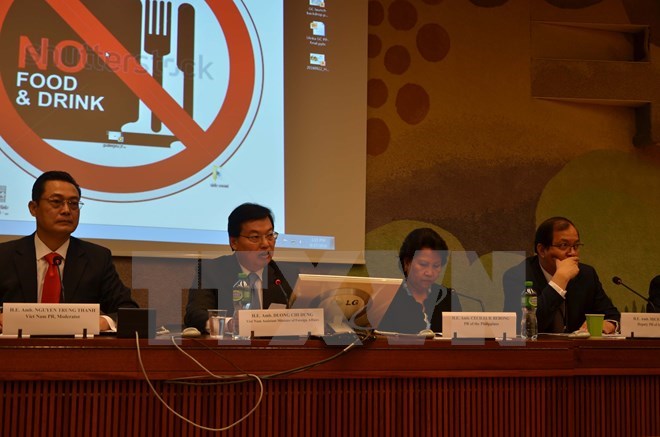
Geneva (VNA) – Vietnam made active contributions to the 33rd session of the United Nations (UN) Human Rights Council, which wrapped up on September 30 in Geneva, Switzerland .

In the spirit of respecting international law, independence, sovereignty, territorial integrity, cooperation, and dialogue to protect and promote human rights, the Vietnamese delegation led by Assistant to the Foreign Minister Duong Chi Dung agreed on 21 draft resolutions.

The resolutions highlight shared concerns of the international community such as rights of old people, children, youth migrants, and indigenous people as well as rights to health, culture, and cultural heritage preservation, among others.

As regards controversial resolutions such as human right issues in Syria and Burundi , Vietnam cast a blank vote to reiterate its principled position of not supporting the approval of resolutions on a country-specific situation without its concurrence. This is also in line with the standpoint of multiple developing countries.

The 33 rd session is the last of its kind of the UN Human Rights Council in 2016. It’s also the last meeting that Vietnam participated as a member from 2014 to 2016.

Over the past three years, Vietnam has proved to be an active, proactive and responsible member with a lot of initiatives and contributions that were internationally recognised.-VNA

Prime Minister’s early inspection trip in the market

16:56 |
The PM Nguyen Xuan Phuc at Long Bien market in the early morning


Early in the morning September 27, before working with the People Committee of Hanoi city on the food safety, Prime Minister Nguyen Xuan Phuc and Deputy Prime Minister Vu Duc Dam had inspected Long Bien wholesale market. This is one of the biggest wholesale markets in Hanoi, providing fruits, agricultural products and seafood for the city's residents and the surrounding areas. Therefore, it is the market that needs to be monitored closely on the issue of food safety and hygiene.
At the market, PM had visited some stores, chatted with retailers and warned them to trade food which must have clear sources and be safe to consumers.
“As retailers, we must keep the morality in trade, not for profit we sell fruits which contain toxic preservatives or don’t have clear sources, causing bad affects for the health of consumers and ourselves”, Prime Minister said.
The early inspection trip didn’t surprise the people here because many of them had been familiar to the close-to-people style of the PM since he was the Chairman of Quang Nam.
Few weeks ago, the convoy, accompanying the Prime Minister, had entered Hoi An ancient town. At that time the PM was not in the car, he was walking to meet people there. But the incident has raised a mixed reaction on the online community. The PM had immediately apologized and claimed his responsibility for bad management of the convoy.
Not only giving his words, right after that, the PM requested the Office of the Government to provide the rule for the participation of the delegation of government leaders. Accordingly, local leaders don’t greet the delegation on the way, just at the arrival. The participation of the delegation of provinces and cities does not include more than 3 cars; officials at the Deputy Minister ranking and below in the delegation must carpool.
The decision is somehow quite strict and tough. However, it shows strong determination of the PM not just by words.
Back to the early morning market trip, the PM went to market not for shopping but to understand and stimulate the people there. As Western writer once said that the best way to understand Vietnam is to go to market, seeing not only the social-economic development, but also the culture of Vietnamese people.
In the other words, the market is a mirror that reflects all aspects of life of the region.
Besides, through the trip the PM want to gather information for the meeting with Ha Noi city on this issue right afterward.
“Apologizing the people”, fixing mistake, inspection by going market early… This is the close-to-people style of the head of the Government. The PM is doing his utmost to build a government of integrity.
We hope that the Prime Minister will continue to spend more time to be close to the people, to listen to the opinions of the people./.

The USCIRF: A biased and prejudiced organization against Vietnam

08:15 |


What is the USCIRF?
The United States Commission on International Religious Freedom (USCIRF) is a U.S. federal government commission created by the International Religious Freedom Act of 1998. USCIRF Commissioners are appointed by the President and the leadership of both political parties in the Senate and the House of Representatives. USCIRF's principal responsibilities are to review the facts and circumstances of violations of religious freedom internationally and to make policy recommendations to the President, the Secretary of State, and the Congress.
USCIRF researches and monitors international religious freedom issues. The Commission is authorized to travel on fact-finding missions to other countries and hold public hearings.
The Commission on International Religious Freedom issues an annual report every May 1. The report responds to a report issued by the State Department Office of International Religious Freedom the prior fall that names countries that have severely violated religious freedom and is intended to critique and expand on the State Department report.
Unfortunately, USCIRF has often held a biased and prejudiced view on Vietnam, especially in human rights issues, and always made wrong and false report about Vietnam’s human rights situations. But it’s not the first time this organization has been accused of that.
USCIRF has placed India on CPC and watch list in 2001, 2002, 2003, 2004, 2009 and 2010. Their report has drawn criticism from the Indian press. The Pioneer, in an editorial termed it as “fiction", "biased”, and “Surpassing Goebbels”. It criticized USCIRF for projecting the massacre of 58 Hindu passengers as an accident. It also accused USCIRF of indirectly justifying murder of Swami Lakshamananda Saraswati, a Hindu cleric and social activist. An analysis of USCIRF 2014 report criticizes USCIRF for promoting religious discord between Hindus and Buddhist, white-wash terror acts, and falsely blaming a Monk for Bodh Gaya bombings 
Christian leaders in Odisha defended India: Archbishop Raphael Cheenath stated that India remained of a secular character, the president of the Odisha Minority Forum that, despite a small hate campaign against minorities, the majority of society had been "cordial and supportive", and the Orissa Secular Front that, despite the 2002 and 2008 riots, India had a strong secular foundation.
Prior to the 2001 visit of the USCIRF to Egypt, some Coptic leaders in Egypt protested, viewing the visit as a form of American imperialism. For example, Mounir Azmi, a member of the Coptic Community Council, said that despite problems for Copts, the visit was a "vile campaign against Egypt" and would be unhelpful. Another critic called the visit "foreign intervention in our internal affairs". In the event, the USCIRF was able to meet the Coptic Orthodox Pope Shenouda III and Mohammed Sayed Tantawi of Al-Azhar University, but others refused to meet the delegation. Hisham Kassem, chairman of the Egyptian Organization for Human Rights, felt that insisting on the rights of Christians in Egypt might antagonize Muslims and thus be counterproductive.
First-ever U.S. Ambassador-at-Large for International Religious Freedom, Robert Seiple, criticized the USCIRF’s emphasis on the punishment of religious persecution over the promotion of religious freedom. In his view, the USCIRF was "only cursing the darkness". As an example, he highlights the Commission’s decision to designate Laos a Country of Particular Concern in 2002 despite release of religious prisoners. Of the USCIRF he further stated “...that which was conceived in error and delivered in chaos has now been consigned to irrelevancy. Unless the Commission finds some candles soon, Congress ought to turn out the lights."
The Commission has also been accused of being biased towards focusing on the persecution of Christians, and of being anti-Muslim. A former policy analyst, Safiya Ghori-Ahmad, has filed a complaint with the Equal Employment Opportunity Commission, alleging that she was fired because she was a Muslim and a member of an advocacy group, the Muslim Public Affairs Council. Current commissioners and some other religious-freedom advocates deny the claims of bias. The commission has also been accused of in-fighting and ineffectiveness.[28]
Jemera Rone of Human Rights Watch said about the report: "I think the legislative history of this Act will probably reflect that there was a great deal of interest in protecting the rights of Christians …. So I think that the burden is probably on the US government to show that in this Act they’re not engaging in crusading or proselytization on behalf of the Christian religion."
According to the National Council of Churches, "the policy will promote the cause of Christians to the exclusion of persecuted believers of other religions."
In a 2009 study of the International Religious Freedom Act of 1998, the Institute of Global Engagement stated that the United States' international religious freedom policy was problematic in that it "has focused more on rhetorical denunciations of persecutors and releasing religious prisoners than on facilitating the political and cultural institutions necessary to religious freedom", and had therefore been ineffective. It further stated that U.S. IRF policy was often perceived as an attack on religion, cultural imperialism, or a front for American missionaries. The report recommended that there be more attention to religious freedom in U.S. diplomacy and foreign policy in general, and that the USCIRF devote more attention to monitoring the integration of religious freedom issues into foreign policy.
In 2005, then Commissioner, Richard Land authored Imagine! A God Blessed America: What It Would Look Like and How It Could Happen. In the book, He wrote that Hindu culture/tradition is "Superstitious" and "Cruel".
Some past commissioners, staff and former staff of the U.S. Commission on International Religious Freedom say the agency charged with advising the president and Congress is rife, behind-the-scenes, with ideology and tribalism, with commissioners focusing on pet projects that are often based on their own religious background. In particular, they say an anti-Muslim bias runs through the commission's work.
From the start, critics say, the commission has disproportionately focused its efforts on the persecution of Christians, while too often ignoring other religious communities and downplaying their claims of persecution.
"It was predetermined who the bad guys are and who the good guys are," said Khaled Abou El Fadl, a Muslim who served as a commissioner from 2003 to 2007 and teaches human rights at UCLA. "There is a very pronounced view of the world, and it is that victims of religious discrimination are invariably Christian. It was rather suffocating."
Biased and prejudiced reports on Vietnam
Everything looks like the same with Vietnam. In its 2016 Annual Report on International Religious Freedom released on 2nd May, USCIRF recommends 17 countries for CPC designation in 2016. Ten are currently on the US State Department’s list: Burma, China, Eritrea, Iran, North Korea, Saudi Arabia, Sudan, Tajikistan, Turkmenistan and Uzbekistan. USCIRF recommends maintaining these ten, and adding seven other countries in which religious freedom is seriously abused: Central African Republic, Egypt, Iraq, Nigeria, Pakistan, Syria and of course Vietnam.
The US State Department designated Vietnam as a CPC in 2004 and 2005, but removed it in 2006 prior to Vietnam’s admission to the World Trade Organization. In August 2015, a delegation of USCIRF Commissioners visited Vietnam to assess the situation of freedom of religion or belief.
 According to the USCIRF’s findings, whereas significant progress has been achieved for some groups in certain areas, “on the other hand, the government’s continuing heavy-handed management of religion continues to lead not only to restrictions and discrimination, but also to individuals being outright harassed, detained, and targeted with physical violence”. The USCIRF noted that, in particular, “religious organizations that choose not to seek government recognition face greater risk of abuse by government authorities”.
Here, we can see unreasonable allegations, it’s common that no country would accept any religious organizations to operate without registration, and any country would punish religious dignitaries and followers who violated or abused laws to hurt the country’s national interests and security.
During the past decade, Vietnam has made a lot of achievements on human rights and religious freedom. The Vietnamese government has started to provide trainings on religion and rule of law, religious freedom, and human rights for academic scholars, government officials working on religious affairs, and public security officials. The government has also partnered with international NGOs and foreign governments to convene seminars on the positive role of religion in society. And now, the Party and State have been gathering opinions from all walks of life to build the law on religions and beliefs, next will be a law on associations in this year. The Vietnamese government fully respects and protects its citizens’ freedom of religion in line with the law, and Vietnamese citizens enjoy the rights to full religious freedom in accordance with the law.
          Report of the United States Commission on International Religious Freedom, USCIRF is biased and not objective. The U.S. ignores this fact and releases reports repeatedly to distort and attack Vietnam’s religious policies and status. Once a again, through the USCIRF the U.S. government has been interfering in Vietnam’s internal affairs. The United States should look to its own problems rather than pointing the finger at others./.
Được tạo bởi Blogger.