Fighting against one-sided and misleading viewpoints on Viet Nam's Defence Policy

16:12 |

 Both the Party's documents and the State's legal documents consistently affirm that the nature of Viet Nam's defence policy is of justice, peace and self-defence. Any misrepresentation that goes against the legitimate interests and aspirations of the country and the Vietnamese people should be condemned and rejected.

The Article 4 of the National Defence Law clearly states: “…neither joining any military alliances, siding with one country against another, giving any other countries permission to set up military bases or use its territory to carry out military activities against other countries nor using force or threatening to use force in international relations; settling all disputes and differences through peaceful means on the basis of respecting independence, sovereignty, territorial unity and integrity, equality and mutual interests"1. The 2019 Viet Nam National Defence reaffirmed: “Viet Nam's national defence policy is peaceful and self-defensive in nature. Viet Nam resolutely and consistently settles all disputes and divergences through peaceful means on the basis of international law…”2. In fact, Viet Nam always strives to properly implement its defence policy with the line of independent and self-reliant defence guideline, building an all-people defence, and a national defence posture in association with a solid people's security posture, creating strength to firmly safeguard the Fatherland. At the same time, Viet Nam is a responsible member of the international community, fulfilling its duties, contributing to the protection of peace and stability in the region and the world. Thus, both its theory and practice consistently affirm the viewpoints and guidelines of the Party, policies and laws of the State of Viet Nam on defence policy in accordance with its history of building and safeguarding the Fatherland, bearing profound nature of humanity; publicity and transparency in order to enhance understanding and build trust with other countries.

However, with malicious intentions and sinister plots, the hostile forces, reactionaries, and political opportunists have taken all possible tricks to oppose and distort Viet Nam's defence policy. They have applied different forms and means, such as: delivering news, articles, and comments, and distributing video clips on YouTube and livestream on social networks; hiding under the guise of so-called "patriots", " fighters for democracy and human rights", criticizing the "National Defence White Paper", etc., aiming to infer, fabricate and distort Viet Nam National Defence policy. They said that Viet Nam's defence policy is outdated and inappropriate; the policy of "not using force or threatening to use force in international relations" means that Viet Nam has "abandoned the use of force in defending the country", "fastening its own hands and feet", "self-isolated", depriving its opportunities to cooperate with major powers to defend its Fatherland. It is also incompatible with the situations, going against the trend of globalization and international integration. They have taken new points in the 2019 Viet Nam National Defence to make comments and baseless accusations on the "Four No's" principle; giving advice, suggestions and recommendations that Viet Nam should establish and join a military alliance. Even more dangerous and blatant, they have also attributed the strengthening of Viet Nam's defence and security potential as initiating an arms race in the region, aiming to fight against a third country. In particular, in the face of complicated developments in the East Sea that have affected the task of protecting sovereignty and security of the sea and islands, the hostile and reactionary forces misrepresented that, with the current defence policy, Viet Nam is unable to maintain its sovereignty, sovereign rights, unity and territorial integrity, etc. Then, they exhort and promote wrong ideas, calling for relying on foreign countries, especially the major powers, and joining military alliances to protect the sovereignty of the sea and islands, and safeguard the Fatherland.

Sr. Lt. Gen. Nguyen Chi Vinh introducing the Viet Nam National Defence White Paper of 2019 (photo: qdnd.vn)

So, what is the fact behind these wrong and one-sided viewpoints of the hostile and reactionary forces that fiercely opposed Viet Nam's defence policy? First of all, it should be affirmed that the nature and purpose of opposing the Vietnamese revolution of hostile and reactionary forces have not changed, but the plots, tricks and tactics are more and more sophisticated and cunning. Secondly, hostile and reactionary forces have looked for ways to lead Viet Nam to join military alliances, gradually falling into the orbit of dependence, then changing the political and social regime. Thirdly, they continue to promote the strategy of "peaceful evolution", "self-evolution", and "self-transformation" internally; "depoliticizing" the Military, moving towards abolishing the leadership role of the Communist Party of Viet Nam and the socialist regime, changing the political system in Viet Nam. Fourthly, they have incited and sowed the skepticism among the people, deceiving, leading public opinion, dividing and destroying the great unity bloc of the whole nation.

In order to fight against these distortions of the hostile and reactionary forces on Viet Nam's defence policy, to firmly defend the Fatherland, it is necessary to successfully implement the following solutions.

Firstlypromoting propaganda activities, clarifying the necessity and scientific nature of Viet Nam's defence policy in the cause of national construction and protection. It is the responsibility of the entire Party, the people, the Military, and the political system to breakdown conspiracies and tricks distorting and opposing Viet Nam's defence policy. All levels, branches, agencies and units should focus on promoting propaganda with diverse and flexible forms and methods suitable to the country's reality and the international context in order to raise awareness and understanding of the people, the overseas Vietnamese, and the international community on Viet Nam's defence policy. Attention should be paid to explaining and clarifying the scientific basis and basic content, affirming that Viet Nam's defence policy is bearing the just, peaceful and self-defence nature, built on the basis of the strength of the great national unity bloc. Viet Nam has always "consistently implemented the foreign policy of independence, self-reliance, peace, cooperation, development, diversification and multilateralization of its foreign relations; ensuring the highest interests of the nation on the basis of basic principles of the United Nations Charter and international law, equality, cooperation and mutual benefit"3. Thereby, it further consolidates the trust of other countries on the peace-loving country and people of Viet Nam. At the same time, emphasis should be placed on actively and proactively propagating, providing official information, guiding public opinion, clearly distinguishing right from wrong, creating significant changes in the people’s awareness, resistance, and immunity to distorted information and wrong and hostile viewpoints.

Secondlystrengthening the Party's leadership and the State's management role in defence work in the new situation. This is a principled issue stated by our Party in the National Construction Platform in 1991, supplemented and developed in 2011; the Resolution No. 28-NQ/TW, dated October 25, 2013 of the 8th Plenum of the Central Committee (tenure XI) on the Strategy for National Defence in the New Situation, and the Resolution of the 13th National Congress. These documents clearly state that in any conditions and circumstances, the Party always upholds its absolute and direct leadership in all aspects for defence tasks and Fatherland protection; raising vigilance, and actively struggling to defeat the hostile forces’ plots and tricks demanding pluralism, multi-party, and "de-politicization" of the Military. The State institutionalizes the Party's guidelines and policies on national defence and Fatherland protection in the Constitution and laws, creating a legal corridor for the performance of national defence and defence tasks. It is necessary to clearly define the operational mechanism, functions and tasks of agencies and officers in charge of national defence in ministries and agencies; coordinated responsibility for each level, branch and locality in defence-related activities. Importance should be attached to stepping up administrative reform and improving the operational efficiency of the State apparatus in the field of national defence; building a contingent of qualified cadres on national defence who are capable of giving advice on the performance of state management on national defence; and promoting the synergy of forces in building a strong all-people national defence.

Thirdly, to build a revolutionary, regular, highly-skilled, and gradually modernized Viet Nam People's Army, meeting requirements of the Fatherland protection. Historical reality has proven that the strength to defend the Fatherland does not come from joining a military alliance but from the internal strength of the Vietnamese people. That is the power of independence, self-control self-reliance and resilience; closely combining the strength of the nation with the strength of the times. The 13th National Congress clearly stated: "Consolidating national defence and security, and firmly defending the Fatherland of the Socialist Republic of Viet Nam are important and regular tasks of the Party, the State, the political system, and the whole people, of which the People's Army and the People's Public Security are the core ones."4 Therefore, building a revolutionary, regular, highly-skilled, and gradually modernized Viet Nam People's Army, with some forces advancing straight to modernity, meeting the requirements of national defence in the new situation is a necessarily objective.

The history of thousand years of national construction and defence, as well as the international practices, shows that it is necessary to defend the Fatherland from afar, when it  is not in danger; preparing synchronously in all aspects, right from peacetime, ready to fight and win any forms of aggressive war. Attention should be paid to building a politically, ideologically, morally and organizationally strong Military, being a political force, a fighting force, absolutely loyal to the Fatherland, the Party, the State and the People; steadfast in the goal of national independence and socialism; proactively and effectively handling unexpected situations. In the coming time, importance should be attached to strengthening the implementation of solutions to adjust the Military organization in the direction of "compact and high-skilled" forces, creating a solid premise to build a modern Military by 2030.

Fourthly, effectively implementing international integration and defence diplomacy, contributing to the maintenance of a peaceful and stable environment for national development. The 2021 National Foreign Affairs Conference affirmed the Party and State's stance on foreign affairs in the new situation, and pointed out conspiracies and tricks to deteriorate the revolution cause and deliberately distort the Viet Nam's foreign policy and defence policy of hostile and reactionary forces. Therefore, it is important to promote defence diplomacy, fostering cooperative relations with all countries, making contribution to protecting the sovereignty and territorial integrity of the Fatherland. Emphasis should be placed on consistently implementing the foreign policy of independence, self-reliance, peace, cooperation and development; being ready to expand defence relations and cooperation regardless of differences in political regimes and levels of development and does not accept defence cooperation relations under pressure or any coercive conditions; resolutely and persistently struggle to settle all disputes and disagreements by peaceful means on the basis of international laws and practices; continuing to contribute substantively and further expand the scale and scope of participation in UN peacekeeping operations; willing to participate in defence and security cooperation mechanisms in accordance to the country's capabilities.

Emphasis should also be placed on strengthening cooperation, building and consolidating trust among countries, contributing to maintaining a peaceful and sustainable environment in the region and the world.

The fight to defeat plots and tricks of hostile forces and political opportunists that sabotage and distort Viet Nam's defence policy is an important task that should be carried out regularly and continuously, so as to make contribution to building and consolidating trust, taking advantage of the consensus and support of international community for the cause of national defence and construction.
Vietnam’s economy to strongly rebound in 2022

16:10 |

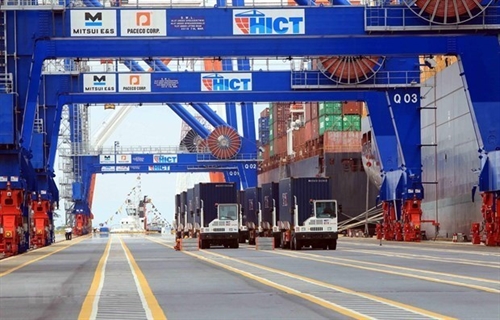
 The Vietnamese economy will recover strongly in 2022, starting at the end of the first quarter, said Tim Leelahaphan, Economist for Thailand and Vietnam at Standard Chartered, at a seminar held in Hanoi on February 18.


At Hai Phong seaport__Photo: VNA

The hybrid “2022 Economic Outlook and Green Finance Policy” seminar, co-organized by the bank and Vietnam’s Ministry of Foreign Affairs, gathered more than 120 officials, diplomats, researchers, businesspeople, and economic experts.

Leelahaphan said Vietnam is expected to grow 6.7 percent in 2022 and 7 percent in 2023, with its medium-term outlook remaining positive. Vietnam will continue to be an important link in the global supply chain and a destination chosen by many businesses, he added.

Investment activity in the country is expected to recover this year after being affected by the COVID-19 epidemic for a period of time, noted the expert.

Michele Wee, Chief Executive Officer at Standard Chartered Bank Vietnam Ltd, said Vietnam's economy is in the process of recovering.

According to her, in a recent survey conducted by the bank, clients said that Vietnam has a lot of potential for growth and investment attraction, and is playing an increasingly important role in international trade and global supply chain.

Addressing the event, Deputy Minister of Foreign Affairs To Anh Dung assessed that Vietnam is entering a very important stage of development with an expectation that its recovery and growth in 2022 and 2023 will create a strong bounce for the 2021 – 2025 period towards development goals set for 2030 and 2045.

Opportunities and challenges are intertwined, but opportunities are dominant, he stressed.

The Government is drastically accelerating the implementation of a largest-ever program for socio-economic recovery and growth, the official informed. According to him, the program includes both short- and long-term solutions to create sustainable development drivers.

Young take great pride in military service

20:07 |
                                                                     Young soldiers

Thousands of young people across the nation from all walks of life are excited and proud to join the army and hope to contribute to protecting the fatherland.

Graduating from Huế University in central Thừa Thiên-Huế Province with excellent academic results in biotechnology, Lê Đắc Hải had many opportunities to find a job with a high income but has registered to join the army instead.

He said he wanted to join the army to train in the military environment and to serve the country.

"I have tried to equip myself with knowledge and skills to be able to adapt to the high-discipline environment of the army and will try to study and fulfil my duty the best I can," he told Vietnamnet online newspaper.

Hải’s father Lê Đắc Thân said he wished his son would be better trained and gain skills in the army to become more mature.
Like Hải, Trần Viết Hiếu from central Thừa Thiên-Huế Province’s Quảng Điền District, is busily preparing to join up.

“I voluntarily registered to join the army. I feel very excited and proud to join the mission to protect the country and uphold the tradition of my family and locality,” he said.

Hải and Hiếu, together with thousands of their peers nationwide, will leave their homes for military service this month between February 16 and 20.

The province’s Military High Command said the selection and recruitment of youths for military services this year met many difficulties due to the pandemic.

Among nearly 1,500 local youths joining the army this year, over 10 per cent graduated from colleges and universities, while 59 per cent graduated from high schools.

The province organised a ceremony to see the young people off for military service on February 16.

In northern Hòa Bình Province, all are ready for the ceremony scheduled to hand over the new soldiers to army units.

Sùng A Phừ, 23, from Mai Châu District, registered to join the army although he is working for a business with a stable income.

“Although I have a stable job, I still want to join the army and follow the fatherland’s call. I promise to train myself and successfully fulfil all assigned tasks,” he told Vietnam News Agency.

His grandfather, Sùng A Tếnh, 78, said he used to be a soldier and was proud to see Phừ follow the older generation and serve. He said he believed that the army would train his grandson to be a better and more mature person.

Nguyễn Văn Lâm, chairman of Mai Châu District’s People’s Committee, said 100 per cent of local youths who joined the army this year were fully vaccinated against COVID-19. Local authorities have visited and presented gifts to the new recruits and will take care of the families of disadvantaged soldiers, he said.

 In northern mountainous Lai Châu Province, 19-year-old Lò Văn Cường from the Giáy ethnic minority group in San Thàng Commune, said he could not hide his feelings on knowing that he was joining the army.

Although the living conditions of his family are tough, Cường was still willing to join. He said that the army would provide him with a good education and training environment. Cường has spent most of his time in recent days at home to help his parents do housework before he leaves.

Hoằng Văn Duy, also from the Giáy ethnic minority group in the commune, said he felt proud to be recruited. “I will strive to fulfil all assigned tasks for the young generation,” he said.

Before registering to join, Duy was working for a company in northern Nam Định Province with a monthly salary of VNĐ5-7 million (US$217-300). However, with a desire to serve the country, Duy decided to temporarily put aside his job to perform military service.

Mission completed

Localities nationwide have reported completing the recruitment targets set for 2022 while strictly following COVID-19 pandemic prevention and control measures.  All the young men joining the army have been given tests for coronavirus.
A delegation from the Ministry of National Defence, led by Deputy Minister  Senior Lieutenant General  Võ Minh Lương, on Tuesday, went to southern Đồng Nai Province to inspect the recruitment process.

Lương said recruitment must ensure high-quality with the aim of building a modern, elite revolutionary army.

The Hồ Chí Minh Communist Youth Union of Hà Nội on February 12 held an exchange to encourage the young people before they leave home.

Secretary of the municipal Youth Union Chu Hồng Minh said that in response to the requirements of national defence, development and protection, the Youth Union has actively mobilised local youths to sign up.

The Youth Union defines the army as a "big school for youths to learn and be trained to help complete tasks."

“Devoting themselves to national construction and defence is the honour, pride and responsibility of Vietnamese youths,” said Chu Hồng Minh. "You temporarily put aside your personal dreams and voluntarily join the army to protect your country. You all are the pride of your families, of the Youth Union and of the city."

VN to build a modern and sustainable agriculture economy by 2030

20:02 |
                                                              Illustrative image

Việt Nam has set an objective to build a modern and sustainable agriculture economy during the 2021-2030 period, said minister of agriculture and rural development Lê Minh Hoan at a conference in Hà Nội yesterday.

In order to realise such objectives, the minister said the country's agriculture sector must foster an advanced economy with an emphasis on producing high-quality products and added value that meet the demands of the market.

Another top priority is to build the country's rural areas and improve living standards for farmers. The minister highlighted the need for the development of agricultural infrastructure and investment in human resources that benefit Vietnamese farmers.

According to the ministry, Việt Nam's agriculture sector aims for a growth target of 2.5-3.0 per cent annually until 2030 with agricultural productivity at 5.5 per cent. Measures have been taken to explore potential markets for Vietnamese products, which was said to increase in value at 5-6 per cent a year.

Hoan said the objective is to transform Việt Nam's rural areas into modern, developed agricultural production centres that employ advanced and environmental-friendly technology by 2050.

The ministry's top priority is the adoption of green technologies with a focus on preserving and protecting natural resources as well as the human habitat. The country is to continue with its restructuring efforts of the agriculture sector in the near future with a focus on developing local products with strong competitive advantages and stronger collaboration among localities and production centres across the country.

Meanwhile, there is a need to conduct a comprehensive review of the country's current land-use regulations, said Trần Công Thắng, head of the Institute for Policy and Strategy for Agriculture and Rural Development.

He advised policymakers to come up with more flexible and effective policies to encourage businesses to invest in agriculture and land-enrichment activities, especially in remote and isolated regions in desperate need of infrastructure.

Việt Nam considers setting up renewable energy centre to realise net-zero carbon commitment

19:58 |
                                          A renewable energy project in Vietnam

The Ministry of Industry and Trade (MoIT) has been asked to coordinate with the Ministry of Natural Resources and Environment (MoNRE) on setting up a renewable energy centre.

The centre will improve human resources training and technology transfer, and share legal experience and national governance in adapting to climate change.

During the 26th United Nations Climate Change Conference of the Parties (COP26) in Glasgow, the UK, Prime Minister Phạm Minh Chính pledged Việt Nam would reach net zero carbon emissions by 2050 and agreed to gradually phase out coal-fired power plants, while calling for international partners’ assistance, especially developed nations who have benefitted from long periods of industrialisation in the past, to help realise the goals.

The implementation of strategies and plans on green growth and climate change adaptation, including contents on Việt Nam’s commitments at COP26, will be submitted to the Prime Minister.

Meanwhile, the Ministry of Justice will work with the MoNRE and relevant ministries and sectors to develop a technical assistance project to call on the UK and development partners to support Việt Nam in internalising its international commitments on climate change, including those made at COP26.

The Ministry of Information and Communications is responsible for coordinating with relevant agencies to build a communications project, including setting up websites on green growth, green energy transformation, digital transformation and climate change.

The MoNRE, the standing body of the Steering Committee, will partner with the Government Office, member ministries and agencies in organising periodic and extraordinary meetings of the committee.

A government notice issued yesterday says that it is necessary to continue to raise awareness of the importance and urgency of the implementation of commitments made at COP 26, in connection with promoting extensive international integration and cooperation with Việt Nam’s strategic partners in order to attract more resources, especially in finance, technology, governance skills, and human resources training to serve economic recovery and development, the implementation of the national green growth strategy and climate change adaptation.

Forecasting the World Order in the Post-Covid-19 Era

21:27 |

 Breaking out at the end of 2019, the Covid-19 pandemic is still complicated and shows no sign of ending. Its overwhelming impact has fundamentally changed the world economic, political, social, security situations and promoted the formation of a new world order.

Accelerating the collapse of the unipolar world order

More than 30 years ago, the bipolar world order ended after the dissolution of the Soviet Union and the socialist system. The U.S. took this historic opportunity to establish its unipolar world order. Without the containment of the Soviet Union, the U.S. unilaterally waged wars and caused many “flashpoints” in the world regardless of international law. This policy not only gets condemnation by the world, but also consumes the U.S too much economic, political and military potentials, pushes this superpower into crises beginning with the 2008 one. America's failure in foreign policy during 30 years after the Cold War is also reflected in the fact that Washington has not been able to impose “American values” on other countries through wars or “regime change”. In particular, the U.S. has failed in “promoting democracy” through the “Rose Revolution” in Georgia, the “Orange Revolution” in Ukraine or the “Arab Spring” in North Africa and Middle East. The U.S. has also failed when using its military might to “promote democracy” in Afghanistan, Iraq or Libya. Meanwhile, China has risen to become the world second largest economy, after the US. As for Russia, over time, it has revived and become a new power of the world. Both China and Russia do not accept the unipolar world order led by the U.S. and coordinate to build a multipolar world order.

Amid that context, the Covid-19 pandemic unveiled the limitations of the globalised capitalism after the Cold War and facilitated the collapse of the unipolar world order according to the “Washington Consensus”. After this pandemic, capitalist countries no longer proclaim themselves a “model” for the whole world and strongly question the statement that the collapse of the socialist system is the “end of history”. At the World Economic Forum 2020, most of the speeches of the world's leading experts and politicians shared that Covid-19 pandemic brought capitalism to a historic turning point when Western countries, led by the U.S., could not decide on a unified strategy to prevent the impact of this pandemic. Even the U.S. withdrew from the World Health Organisation – the head agency in the fight against the spread of SARS-CoV-2 virus.  Therefore, leaders, statesmen and experts, including the United Nations Secretary-General Antonio Guterres; World Economic Forum Founder and Executive Chairman Professor Klaus Schwab and IMF president Kristalina Georgieva proposed a joint initiative called “The Great Reset” to innovate the world capitalism model. Speaking at the British Royal Air Force (RAF) Mildenhall base in his long trip to Europe in June 2021, U.S. President Joe Biden said: “No single nation acting alone can meet all the challenges we face today because the world is changing”. He  called on countries to work together to build a the world shared future, in which the U.S. will no longer behave in a coercive way with other countries and to overcome the Covid-19 pandemic and other similar threats in the future requires international cooperation and coordinated multilateral action. This speech can be considered the end of the unipolar world order led by the U.S. after the Cold War.

Trends in building a New World Order - Yalta 2.0

When the Second World War was about to end, in February 1945, the 'Big Three' Allied leaders from  the Soviet Union, the U.S and Great Britain, held a historic conference in the city of Yalta to decide on the basic principles of the post-war world order. Therefore, the world order established after the Second World War is often called the "Yalta Order" or Yalta 1.0. Today, the Soviet Union no longer exists, and the roles of the U.S. and United Kingdom have also changed radically. Meanwhile, China, the European Union, India and Japan are developing towards world powers, in which China is rising to a world superpower. Therefore, leaders of many countries believe that it is time to reshape the current international relations because they are outdated for a new world order.

This idea had been discussed before the outbreak of the Covid-19 pandemic, but due to stagnation in political thinking, many world leaders are not ready to accept a new world order that is taking shape. In that context, the Covid-19 pandemic is considered a strong driving force to realise ideas and efforts for a new world order, in which all countries, including the U.S., will have to adapt to a different world order to meet the challenges of the post-Covid-19 pandemic era. According to Russian President Vladimir Putin, Russia inherits the status of the Soviet Union and has become a responsible power to international community. U.S. President Joe Biden also holds that Russia is a new power and will join with the U.S. to ensure strategic stability of the world. Therefore, it is necessary to maintain all the basic institutions of the previous World Order, or the Yalta 1.0, such as the United Nations and its Security Council consisting of five permanent members: the U.S., Russia, China, the United Kingdom and France. These 5 countries have veto when discussing war and peace issues. President Vladimir Putin holds that it is necessary to base on the Yalta 1.0 Order to gradually adjust the structure of world political institutions in accordance with the new international context in order to neutralise the global threats that cannot be solved by a single country, even though it is the most powerful one in the world.

 The New World Order - Yalta 2.0 has recently been mentioned by leaders of some regional powers. Turkish President Tayyip Erdogan said that “the world is bigger than five” which implies the preferences and expectations of the humanity should no longer be held captive to the will of the five permanent members in the United Nations Security Council, the winners of the Second World War. The reform of the United Nations Security Council was approved by the majority of member states. On November 16 and 17, 2021, the United Nations General Assembly met to discuss the reform of the Security Council. At the meeting, a majority of member states agreed to increase the number of permanent and non-permanent members of the body, in order to ensure fair representation of Asia, Africa and Latin America. President Vladimir Putin proposed a summit of five members of the Security Council to discuss a new world order. The initiative has been accepted by U.S., China, United Kingdom and France, but postponed due to the Covid-19 pandemic. Analysts say that this conference can be considered as the Yalta 2.0 Conference to discuss a New World Order to solve global challenges in the post-Covid-19 pandemic era, that no country or group of countries can resolve.

The trend of a new bipolar world order

If the Yalta 1.0 Order after World War II was based on two poles of the U.S. and the Soviet Union, the Yalta 2.0 Order is also based on two new poles, in which one is the U.S., and the other is the combination between China and Russia. After taking office in early 2021, in his speech to the U.S. Congress, President Joe Biden said that the 21st century will see competition between a “democratic coalition” led by the U.S. and the “autocratic” states led by China and Russia. Therefore, on December 9 and 10, 2021, President Joe Biden held an online Conference of Democratic States with the participation of more than 100 countries. China and Russia, of course, were not invited as they are considered “authoritarian”. In fact, the competition between “democratic” and “autocratic” countries is the competition between the U.S. and China and Russia. While the former is trying to save its hegemony which has lost its legitimacy, the latters are banding together to reject the unipolar world order led by Washington. In particular, China’s ambition is to become a socialist power leading the world in a new era by 2049. Thus, the China-Russia bond will hold a pole in the new bipolar world order.

With regard to the U.S.-China relations, the Covid-19 pandemic is escalating the comprehensive strategic competition between the two countries in all fronts: (1). Between the model of socialism with Chinese characteristics built on the basis of the political system led by the Communist Party of China and the state-governed market economy with the American capitalist model based on free market economic foundation; (2). Trade war; (3). Competing for the No. 1 position in the Fourth Industrial Revolution; (4). Between China's “Belt and Road” (BRI) initiative and America's “Democratic BRI”; (5). Between USD and renminbi position; (6). The East Sea - where the U.S. completely rejects China's unreasonable sovereign claims; (7). Taiwan - where Washington fully supports Taipei government, while Beijing considers it an intervention into China's sovereignty; (8). Arms race; (9). Human rights - where the U.S. accuses China of human rights abuses in Xinjiang and Hong Kong, etc.

The confrontational nature in the U.S.-Russia relations is even more intense than in the Cold War period. In particular, the U.S. unilaterally withdrew from many treaties signed with the Soviet Union/Russia, such as: the Anti-Ballistic Missile Treaty, the Intermediate-Range Nuclear Forces Treaty, and the Open Skies Treaty. Against such backdrop, China and Russia are more willing to bond together to neutralise challenges from the U.S. Speaking at the 2020 Valdai Discussion Club, President Vladimir Putin said that Russia and China have built an unprecedented high level of trust and effective cooperation, and can even move forward to a military alliance in the face of increasing pressure from the US.

Thus, in the post-Covid-19 era, the world order is still evolving into multipolarity and multi-centre. Major powers still cooperate and compromise, but will see fiercer competition and containment.

Vietnam shares experience in poverty reduction, crisis settlement at UN CSocD session

20:40 |
                                                             Rice harvesting in Vietnam

Vietnam shared experience in promoting poverty reduction and overcoming difficulties during crisis at the 60th session of the UN Commission for Social Development (CSocD) that is taking place from February 7-16 in New York.

Addressing the session, themed “inclusive and resilient recovery from COVID-19 for sustainable livelihoods, well-being and dignity for all: eradicating poverty and hunger in all its forms and dimensions to achieve the 2030 Agenda”, Ambassador Dang Dinh Quy, Permanent Representative of Vietnam to the UN, stressed that post-pandemic recovery has yet to be equal across the world.

The process of implementing sustainable development goals (SDG) in 2030 has been interrupted, especially the goal in poverty reduction, he noted.

The ambassador underlined that sustainable poverty reduction can only be reached if threats in food security is settled and relevant legal frameworks and policies focus on easing reduction and inequality as well as capacity improvement and the ensuring of livelihoods for all people.
Ambassador Quy held that in order to ensure food security, which is an important foundation for poverty reduction, countries should strengthen investment in science, technology and renovation in the agricultural sector to increase its productivity, resilience and sustainability.

Vietnam is willing to engage in UN cooperation frameworks and hopes to become a food innovation centre of the region, he said, highlighting comprehensive measures and achievements of Vietnam in poverty reduction and food security protection. Vietnam commits to fully realising SDGs for a sustainable future for all people, he affirmed.

Measures proposed by Vietnam at the session focus on dealing with the root cause of poverty and inequality, including strengthening education and training and job creation, and improving the connectivity among social welfare policies and agriculture. The international should increase multilateral cooperation and optimise resources for comprehensive recovery and settle debt crisis, said the Vietnamese representative.

At the session, UN Secretary General Antonio Guterres said that post-pandemic recovery is a chance for countries to build and develop long-term policy frameworks to achieve SDGs.

Meanwhile, Abdulla Shahid, President of the UN General Assembly, stressed the need to draw lessons for post-pandemic period, calling for the integration of SDGs into the plans of reconstruction for better, and proposed a number of measures in the work.

Collen Vixen Kelapile, President of the UN Economic and Social Council, said that developing countries, especially those in Africa, is being left behind with slow economic growth and poor access to vaccines and financial resources for their recovery.

Participants shared their experiences and initiatives on social policies to minimise impacts of the pandemic, especially to poverty reduction and the settlement of food security challenges./.

Vietnam eyes to be responsible, sustainable food supplier: Minister

20:38 |
                                                            Illustrative image

Vietnam aims to become a transparent, responsible and sustainable global supplier of food and foodstuff, Minister of Agriculture and Rural Development Le Minh Hoan said in a signing ceremony for a cooperation deal between his ministry and the WWF in Hanoi on February 14.

The Ministry of Agriculture and Rural Development and the World Wide Fund for Nature (WWF) inked a Memorandum of Understanding (MoU) on "Strengthening cooperation in agricultural development and 2022 - 2026 One Health Partnership on Prevention of Zoonotic Diseases".

Addressing the event, Minister Hoan reiterated Prime Minister Pham Minh Chinh’s COP26 commitment on turning Vietnam into a carbon-neutral economy by 2050. To this end, the country aims to promote the efficient use of land and natural resources and agricultural inputs.

Agriculture has contributed greatly to the economy after more than three decades of “Doi moi” (Renewal), the minister said. Vietnam acknowledges that growth can cause loss of many ecosystems so the country consistently pursues a strategy of developing agriculture without paying costs, whether tangible or intangible, like biodiversity and environmental costs, he explained.

Vietnam will not only make use of its nature but also protect the environment, landscapes and biodiversity towards green growth and consumption, he said, adding that the country plans to accelerate sustainable agricultural and rural development based on three main pillars, namely eco-agriculture, modern rural development and smart farmers.

He spoke highly of WWF’s leading role in conserving biodiversity, building a sustainable future for people, sustainably managing natural resources, and providing consultancy and support for the Government of Vietnam to address challenges hampering national and sectoral development.

The ministry wants to foster comprehensive partnership with WWF in multiple areas, including forestry and wildlife protection, ocean (fishery and ocean plastic waste management), irrigation, natural disaster risk management, rural development, food security, agricultural trade, environment protection, climate change and biodiversity, he said.

WWF will be among the government’s strategic partners in conservation in the next decade, the minister emphasized.

WWF Global Director Prasanna De Silva, for his part, said WWF acknowledges the Vietnamese government’s commitment on reversing biodiversity losses domestically and globally./.

Được tạo bởi Blogger.