The relationship between “the Party’s leadership, the State’s management and the people’s mastery”

20:37 |

 With reference to the orientations for the country’s development in the period of 2021-2030, according to the Draft Report for submission to the 13th National Party Congress, it is vital to “continue grasping and well handling major relationships,” including the one between the Party’s leadership, the State’s management and the people’s mastery which will play a pivotal role in our revolution’s destiny, survival and development.

1. “The Party’s leadership, the State’s management and the people’s mastery” as the nature of socialist countries, including Vietnam. State and social structure within the Soviet Union and the system of socialist nations in the 20th century consisted of three main parts, namely Communist Party, State, and people. The three components were in a dialectical relationship. More specifically, the Communist Party would play the leadership role, the State as the supreme national representative would perform its functions in home and external affairs, and the people would have mastery over the execution of leadership guidelines and the elections to establish the state apparatus and enjoy their country’s achievements. In our country, since its inception, our Party has creatively applied Marxism-Leninism, fostered the value of national tradition and determined that “the Communist Party of Vietnam was founded to lead the labouring people in the revolution against imperialism towards communism.” After the success of the 1945 August Revolution, under the leadership of our Party and President Ho Chi Minh, on January 6th, 1946, the Provisional Government organised the General Election under universal suffrage, establishing the National Assembly as the first legislative body, marking a turning point in the new-style State’s history. Since then, the society in Vietnam has had sufficient three main parts, namely Party, State and people. At its 2nd Meeting, on November 9th, 1946, the 1st National Assembly enacted the first Constitution, according to which “Vietnam is a democratic republic; all powers within the country belong to all Vietnamese citizens.” It also promulgated the regulations on offices’ authorities, functions and tasks, job titles within the state apparatus, and amendment to the Constitution. While leading the country’s revolution, our Party has always set up and well managed the relationship between “the Party’s leadership, the State’s management and the people’s management.” As a result, it has positively changed the Vietnamese nation and people’s destiny and led the revolution to numerous victories. Currently, Vietnam is a developing nation with the per capita income of nearly 3,000 USD/year (2019); it has become an active, responsible member of the international community and most of the global organisations. Never has our country had such great potential, status and prestige.

2. The nature of the relationship between “the Party’s leadership, the State’s management and the people’s mastery” in our country. This is a dialectical relationship between the three main components within the society. Although there is a difference in each part’s position, role and impact, they all share the goal of facilitating social progress.

The relationship between the Party and the State could be seen as the link between the subject of leadership and the one who realises that leadership. To defend the revolutionary fruits and represent the people to manage and maintain social development and perform the function of an independent state on an equal footing as others, the Party has led the people to establish the system of governments from Central to local levels (hereafter the State for short). Cadres and members of the Party and the State would be responsible for leading the people to successfully implement all guidelines, policies and laws by the Party and the State. Thanks to that organisational procedure and the achievements over the past 90 years plus, our Party and its rule have always been trusted and recognised by our people. Under the unitary mechanism, the Party controls and uses the State power and leads the State and the entire people to attain its goal. Nevertheless, the Party does not do all things for the State; it does not stand above or outside the State; it is part of the political system; each cadre and party member must live and work in conformity with the Constitution and law. Since the inception of the State, our entire Party, Military and people have always strived to build and perfect a socialist rule-of-law State of the people, by the people, and for the people. We have always devoted efforts to building a pure, strong, compact, effective state apparatus with the integration of powers (legislative, executive and judiciary) in order to institutionalise, concretise and realise the Party’s guidelines. To that end, the National Assembly will be responsible for formulating and adopting laws under a close, democratic procedure in accordance with the developments of reality. Management by the Government and all-level authorities will be flexible, dynamic and creative to foster the country’s rapid, comprehensive development in most of the fields and maintain politico-social stability. National defence and security will be strengthened unceasingly while national independence, sovereignty, unification and territorial integrity will be firmly protected. Foreign relations and international integration will be made deeper, wider, and more effective. The judiciary work will play an important role in maintaining and strictly defending the Constitution and law. Without any “restricted area,” over the years, we have investigated and prosecuted many cases, including the serious ones involving many senior cadres under the law, thereby keeping and consolidating the people’s faith in the Party, the State and the socialist regime.

The relationship between the Party and the people is the connection between the subject of leadership and the one who directly plays a decisive role in the outcome of leadership and enjoys achievements gained from the leadership. Inheriting and applying the viewpoints on the masses’ role and strength, such as “the people are like water which can move and sink the ship,” “there is nothing more precious than the people in the sky and nothing is stronger than the people’s unity in the world,” our Party has determined to “maintain a close-knit bond with the people, respect and promote the people’s right to mastery, rely on the people to build the Party, and submit to the people’s supervision.” For the sake of “wealthy people, strong nation, equality, democracy, and civilisation,” all activities of the Party have been aimed at the people’s benefits and legitimate aspirations. The Party has frequently grasped and realised the ideology on “people as the roots,” while encouraging the people’s right to mastery. Hence, one of the central tasks of the Party is to preserve and consolidate a close-knit bond with the people and rely on the people for the Party building. The people are those who directly implement the Party’s guidelines and enjoy the achievements obtained from the Party’s leadership. The people make the country’s history and they are the true masters of the country. The quality of the people’s life and the country’s social progress are the most persuasive evidence for the Party’s capability in leading our country’s revolution.

The State-people relationship is the link between masters and “servants.”  According to the current Constitution - our country’s supreme law, “the people are the masters of the Socialist Republic of Vietnam; all state powers belong to the people; the people exercise the State power under the forms of direct democracy and of representative democracy through the National Assembly, the People’s Councils and other State agencies.” Therefore, “all state agencies, cadres, officials and employees must show respect for the people, devotedly serve the people, maintain close contact with the People, listen to their opinions and submit to their supervision.” On the behalf of the people, the state apparatus is established to manage and operate the society, facilitate social development, and perform its functions in home and external affairs under the Party’s leadership. The State manages the society by means of the Constitution and law, protects and ensures sufficient rights and legitimate benefits of its citizens, and assists the people in successfully building socialism and defending the Socialist Vietnamese Homeland. At the same time, it uses the tool of power granted by the people to repress and punish violations of law, detriments to the people’s peace, freedom and happiness as well as acts of sabotage against our country’s revolution. In this regard, the Constitution of 2013 stipulates that “a representative of the National Assembly and a representative of a People's Council shall be revoked from office by the electors or the National Assembly or the People's Council, when he or she is no longer worthy of the confidence of the people.”

The nature of the relationship between “the Party’s leadership, the State’s management and the people’s mastery” acts as a determinant to the Vietnamese revolution’s development. All activities of the Party and the State are for the people and commissioned by the people: “all interests must be for the people; all powers must belong to the people; the people are responsible for national renewal and construction; governments from central to commune levels are elected by the people; unions from central to commune levels are organised by the people; in short, powers and forces are in the palm of the people’s hand.”

3. To well manage the relationship between “the Party’s leadership, the State’s management and the people’s master” in the new situation. The entire Party, Military and people must be fully aware of this relationship and adopt synchronous measures, with a focus on the main ones as follows.

First, enhance the work of education and propagation to render all cadres, party members and citizens fully aware of the relationship between “the Party’s leadership, the State’s management and the people’s mastery.” Great value should be attached to clarifying the role, function, task, authority and social responsibility of each component so that each person will well perform their civic duties assigned by the Party, the State, the people and the society.

Second, frequently build a politically, ideologically, morally, organisationally strong and pure Party and raise its leadership capacity and combativeness. Consideration should be given to improving the Party’s capability in forecasting and developing guidelines and policies. Mechanisms for closely controlling powers should be quickly completed. Due attention should be paid to resolutely, persistently preventing and fighting against corruption, wastefulness, and the signs of “self-evolution” and “self-transformation” within the political system and amongst cadres and party members.

Third, build a socialist rule-of-law State in line with the training of cadres and officials within the state apparatus. It is necessary to manage the society by the Constitution and law and ensure that all state powers belong to the people and all activities of the State are aimed at “wealthy people, strong nation, democracy, equality and civilisation.”

Fourth, effectively, practically expand democracy, maintain discipline, and strengthen socialist legislation so that the people are the true masters of the country. Our country’s benefits and strength must be in agreement with the people’s interests and power. The Party and State’s function and mission are to protect and serve the people. Their powers are commissioned by the people. Party members, cadres, and officials must be loyal “servants” of the people.

Fifth, actively, proactively identify and combat the hostile forces and bad elements’ new artifices and strategies aimed at sabotaging our revolutionary fruits, “capitalising” Vietnam, separating the Party from the people, and destroying the relationship between “the Party’s leadership, the State’s management and the people’s mastery.”

Impact of COVID-19 on Women and Children

20:16 |

 The impacts of crises are never gender-neutral and COVID-19 is no exception. The pandemic has resulted in increased rates of violence against women and has exacerbated challenges in accessing justice. Women are losing their livelihoods faster than men.

Millions of women are assuming disproportionate responsibility for caregiving. Many women have found themselves unable to access contraception and other sexual and reproductive health services. UN experts predict that as many as 13 million more child marriages could take place over the next 10 years because of COVID-19 shutdowns of schools and family planning services combined with increasing economic challenges.

Women and girls from marginalised and minority communities are especially at risk – in the United Kingdom for example, black women are over four times more likely than white women to die from COVID-19.

COVID-19 risks damaging much of the progress towards gender equality that myself and other women activists have spent our lives working towards. As the Chair of The Elders, a group of independent global leaders brought together by Nelson Mandela, I have the privilege to work alongside two other women who were, like me, the first women leaders in their countries - Gro Harlem Brundtland of Norway, and Ellen Johnson Sirleaf of Liberia. I also seek to serve Mandela's vision of a world of peace, justice and human rights alongside pioneering human rights lawyer, Hina Jilani, who set up the first law firm for women in Pakistan and Graça Machel, a tireless fighter for women's education and emancipation. We are all deeply concerned that women already seem to be bearing the brunt of the socio-economic fallout from COVID-19, and that this pandemic may deepen the gender inequality rift.

This year we commemorate the 25th anniversary of the Beijing Declaration and Platform for Action, where representatives from all 189 nations committed to "the full and equal participation of women in political, civil, economic, social, and cultural life." We have made positive strides in the last 25 years: more girls than ever are completing primary school; the proportion of young women married as children has declined globally from 1 in 4 to approximately 1 in 5.

However, as a major report to mark the anniversary notes, we now need a new roadmap for progressing gender equality that draws on the wisdom and experience of leading women from across every sector, as well as new younger voices.

COVID-19 has starkly exposed underlying inequalities and reminded us all that rights on paper are not necessarily rights in practice. I am disappointed at the slow progress on women's political representation and leadership. Fifteen countries now have women in the highest position of political power – up from 5 in 1980, but down from the peak of 18 in 2018. The number of women in parliaments remains less than 25 percent on average. This under-representation of women in positions of political power and influence appears to be replicated within COVID-19 task forces. However, we have seen that countries led by women seem to have been very effective in managing the pandemic.

Seeing how women and girls are rising to respond to the challenges posed by the pandemic is what gives me hope and spurs me on. The examples are many. Dejana Stosic leads a civil society organisation in Serbia, Human Rights Committee Vranje, that provides a free 24-hour online service to support survivors of gender based violence. Jamie Margolin is a young climate activist using her platform to raise awareness about the intersection of COVID-19, the climate crisis and racial injustice. Ellen Johnson Sirleaf is working with several women leaders across Africa who are successfully advancing the fight against COVID-19.

Women's leadership at all levels must be at the core of the response to the pandemic if we are to prevent a roll back on women's rights. We need to support the collective action of women, particularly grassroots groups, and stand in solidarity with, and encourage, the next generation of leaders.

History has shown us that crises can also produce some of the most seismic changes. One of my great feminist heroines is Rosa Luxemburg, who fought for freedom in Poland and Germany before, during and after the First World War. Just over a century, she declared that "freedom is always freedom for the one who thinks differently".

Now, more than ever, we need to think differently about justice and gender equality. As the world charts a course for a post-pandemic future, we need to draw on our collective strength - rethink, reset and build a better world for future generations.

ASEAN parliaments hail Việt Nam’s AIPA Presidency

20:48 |


The most outstanding result of the 41st General Assembly of the ASEAN Inter-Parliamentary Assembly (AIPA-41) was the building of solidarity within AIPA, and the host Việt Nam played an important role in this regard, said Chairwoman of the Lao National Assembly (NA) Pany Yathotou in an interview with the Vietnam News Agency following the conclusion of AIPA-41.

“The 41st General Assembly of AIPA demonstrated the Vietnamese NA’s high sense of responsibility, creativity, capacity, and experience in organisation,” the top Lao legislator said.

She said all participating parliaments highly valued Việt Nam’s organisation capacity given the complexity of COVID-19.

The country has made every effort to fulfil its AIPA Chairmanship role, she went on, adding that it employed good consultation mechanisms with other AIPA member parliaments, helping accelerate the ratification of resolutions.

She also said issues on the agenda were significant for the region and met the aspirations of ASEAN residents.

The spirit of the meeting will be upheld in reality, with attention paid to co-operation with governments in implementing resolutions adopted by ASEAN leaders, especially those regarding the fight against the pandemic, she said.

The Lao NA will also continue with its role in issuing laws that serve as a foundation for the realisation of the resolutions, she noted.

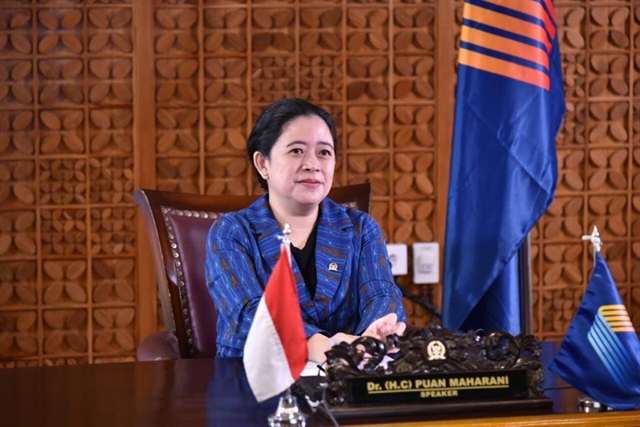
Puan Maharani, Speaker of the House of Representatives of the Republic of Indonesia, said she fully appreciated Việt Nam's effort in hosting the first-ever AIPA virtual General Assembly.

Puan Maharani, Speaker of the House of Representatives of the Republic of Indonesia.

“We appreciate the efforts of the Vietnamese National Assembly for hosting the 41st AIPA General Assembly despite the challenges that we are all facing due to the pandemic and hope that this year’s General Assembly could become an effective platform for AIPA member parliaments to exchange best practices, build political will, strengthen capacity, and foster collaboration among parliaments and parliamentarians on curbing the pandemic as well as to find best solutions to other important regional issues.”

“The fact that overall the AIPA General Assembly went very well despite being conducted online, is an accomplishment on its own. In the past, many might think that this kind of level of international event would not be doable online. However today AIPA has proven that we can adapt with development and that AIPA is well prepared for the future,” she said.

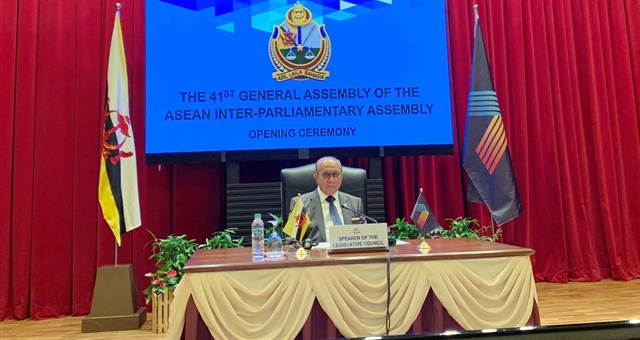
Talking to Vietnam News Agency after the closing ceremony of AIPA-41, Pehin Abdul Rahman Taib, Speaker of the Legislative Council of Brunei Darussalam, said a notable achievement of the General Assembly this year was the resumption of the meeting of Committee on Political Matters.

Pehin Abdul Rahman Taib, Speaker of Legislative Council of Brunei Darussalam.

Việt Nam’s AIPA Presidency, under the leadership of Vietnamese NA Chairwoman Nguyễn Thị Kim Ngân, must be commended, he said, adding that the Vietnamese NA “has successfully demonstrated its steadfast commitment and dedication as well as upheld its duties and responsibilities in convening the AIPA General Assembly during its AIPA presidency, in a time when our region and the world are still facing the effects of the COVID-19 pandemic."

The Legislative Council of Brunei Darussalam appreciates the Vietnamese NA’s efforts in bringing AIPA member parliaments together to attend the General Assembly virtually, he said.

Remote examination and treatment project enhances health caring

20:45 |


 Remote medical examination and treatment has been deployed in many hospitals such as Hanoi Medical University Hospital, National Children's Hospital, Hanoi Heart Hospital, etc. to connect to dozens of hospitals in provinces across the country.

The Ministry of Health is implementing a remote medical examination and treatment project for 2020-2025 to ensure the sustainable development of the health sector.

The system has been deployed in many hospitals such as Ha Noi Medical University Hospital, National Pediatric Hospital, Ha Noi Heart Hospital and K (Cancer) Hospital. It is estimated that when implemented nationwide, it will save the health sector tens of thousands of billions of đồng each year.

The remote medical examination and treatment project is one of the focuses of the Ministry of Health at this time to build an unlimited medical network between all levels of health care facilities nationwide.

Counselling and support for the grassroots levels is one of the tasks of training and direction of central and upper-level hospitals. This is an activity that has been implemented in a number of medical examination and treatment facilities. However, during the COVID-19 pandemic and amid emerging diseases, there are new risks, requiring the health sector to take drastic measures to meet both epidemic prevention and socio-economical development goals.

The project is built to help strengthen the professional capacity of the lower level hospitals, to help them achieve higher quality of treatment.

The project’s goals are that all people will be consulted, examined, treated, and professionally supported by doctors from the communal to the central level; and that people can use higher-quality health care services at lower-level medical establishments. Staff of medical facilities will receive regular and irregular professional support from higher-level hospitals based on information technology. This will contribute to disease prevention, reducing hospital overcrowding at higher levels, as well as improving the quality, efficiency and results of medical examination and treatment.

During the COVID-19 pandemic prevention period, the Ministry of Health has applied information technology solutions to implement remote treatment counselling and treatment. The National Steering Committee has established a centre for management and administration to support professional diagnosis and treatment of COVID-19 patients.

The centre regularly organises online conferences and invites leading professors across the country to consult on serious cases, discuss optimal treatment methods for patients and share treatment and care experiences. Information technology has helped bring together the team of leading experts and hospitals closer together and there is almost no geographic distance between regions and between the upper and lower levels.

The establishment of such a management and administration centre marked the development of the medical examination and treatment system in the trend of applying advanced scientific and technological achievements in disease treatment, especially with the COVID-19 pandemic.

This further confirmed the effectiveness of information technology in implementing remote treatment and counselling activities. The case of the British pilot, patient 91, is a typical example. Leading experts regularly held online conferences to find the best solutions for treatment and thanks to that, the patient made a miraculous recovery.

The management centre for diagnosis and treatment of patients COVID-19 was built and developed in the first days when the outbreak began and had been recognised as one of seven works that were honoured in the Golden Book of Vietnamese Creativity by the Central Committee of the Viet Nam Fatherland Front./.


Major tasks, solutions to advance development of key economic regions

21:17 |

 The Government has recently issued Resolution 128/NQ-CP on major tasks and solutions to advance the development of key economic regions (KERs). 

Illustration photo

The Government set up four KERs, including the northern key economic region (comprising seven provinces and cities); the central key economic region (five provinces and cities), the southern key economic region (eight provinces and cities), and the Mekong Delta key economic region (four provinces and cities). 

The four regions contribute nearly 73% to the national average GDP growth rate, serving as a driving force for the economy. 

Especially, in the 2011-2019 period, the northern key economic region and the southern key economic region occupied over 61% of the national GDP.

However, potential and advantages of the KERs have yet to be fully tapped while those regions are struggling against numerous challenges, including contracting economic growth, limited capacity of human resources, inefficient coordination among localities in each region, and environmental pollution among others.

In addition, the COVID-19 pandemic has had multi-faceted impacts on the regions’ goals like economic growth, export, State budget collection and tourism development. 

Against the backdrop, the Government tasked these regions’ localities to overcome difficulties and optimize potentials and advantages to rise up in favor of national development.

The KERs were urged to perfect mechanisms and policies on regional connectivity coordination and develop national and regional master planning schemes in the 2021-2030 period with a vision towards 2050.

The KERs must also clarify appropriate sectors and fields in accordance with their comparative advantages to further strengthen foreign investment attraction while taking the lead in innovation and startup as well as IT application.   

The Government will allocate appropriate investment resources for the KERs in the next five years, particularly, investment capital for PPP projects, read the resolution.

The Ministry of Finance was assigned to put forward mechanisms regulating the annual budget retention rate of major metropolises in the 2022-2025 period. At present, Ho Chi Minh City, which contributes 24% of the country’s GDP and 27% of the national budget, is only allowed to keep 18% of its annual budget, thus hampering infrastructure investment development.

The State Bank of Viet Nam was asked to direct credit organizations to mobilize and steer idle capital to support the development of the KERs.

The Ministry of Transport was asked to prioritize allocated capital for transport infrastructure development and other mega projects with an aim to strengthen intra-regional and extra-regional connectivity.

The relevant People’s Committees are responsible for mobilizing and effectively utilizing resources, including official development assistance and private capital for their major projects. 

Earlier, in this June, Prime Minister Nguyen Xuan Phuc has directed ministries, agencies and localities to boost the development of KERs, contributing to supporting the recovery of the economy amid COVID-19 pandemic period. 

The northern key economic region shall focus on attracting hi-tech, processing, manufacturing, electronics, service, banking, finance and logistics projects and create research and development centers. These centers shall help stimulate the application of technology and science and innovation.

The central key economic region shall put the marine economy development a priority. Also, the region shall develop the eco-system for the automobile industry, transport services and tourism.

Meanwhile, the southern key economic region shall attract large-scale and hi-tech projects to build up value chains.

The Mekong River Delta shall focus on growing hi-tech agriculture, agriculture processing industry, and tourism of Phu Quoc Island. Moreover, the region shall efficiently implement measures to promote the regional sustainable development and cope with climate change./. 

ASEAN to further promote human rights and women's role

21:11 |

 Within the framework of the 53rd ASEAN Foreign Ministers’ Meeting (AMM-53), Deputy Prime Minister and Foreign Minister Pham Binh Minh on September 10 chaired the ASEAN Foreign Ministers’ Interface with AICHR Representatives, and the ASEAN Ministerial Dialogue on Strengthening Women’s Role for Sustainable Peace and Security.

Dong Tam case's defendants seek clemency

20:05 |


 Le Dinh Cong, one of six defendants charged with “murder” over the killing of three police officers in Dong Tam commune in Hanoi’s My Duc district, asked on September 10 that his charge be changed to “resisting on-duty officers”.

During the trial in the Hanoi People’s Court, Cong showed remorse and begged for clemency.

He continued to insist that he did not discuss the incident early on the morning of January 9 with anyone.

Cong said he had not been fully aware of the death of the policemen, but after learning about it he felt deeply remorse.

Le Dinh Chuc, who faces the same charge, extended an apology to the families of the deceased and asked for forgiveness.

Le Dinh Doanh, another defendant charged with “murder”, also displayed remorse and sought clemency.

The other defendants charged with “murder” are Bui Viet Hieu, Nguyen Quoc Tien, and Nguyen Van Tuyen. The Procuracy said the six had demonstrated a clear motive and intent to kill on-duty officers.

According to the Procuracy, the six were the masterminds of the crime and also led and directly committed criminal acts. They closely colluded with others who were key members of a so-called “group of consensus” led by Le Dinh Kinh - father of Cong and Chuc. Kinh was shot dead while holding a grenade and calling on the others to resist those on-duty.

The trial of the 29 defendants in the case began on September 7 and the jury is scheduled to issue a verdict on September 14./.

Vietnam News Agency’s anti-fake news project wins int’l prize

20:01 |


Marking the 75th anniversary of the Vietnam News Agency, there a good news that a special anti-fake news project from the Vietnam News Agency (VNA) has been named Best Project for News Literacy within the Asian Digital Media Awards 2020, organised by the World Association of News Publishers (WAN-IFRA). The prize will be officially announced at WAN-IFRA’s Digital Media Asia 2020 event on October 15.

The VNA project consists of three parts: an anti-fake news song in 15 languages; a TikTok account called Factcheckvn targeting young people; and the “Say No to Fake News” training programme.

The song, “No Fake News” was released on March 27 and immediately caught widespread attention. A version with English subtitles was released the following day, followed by 13 other versions in French, Spanish, Russian, Italian, German, Chinese, Japanese, Korean, Arabic, Thai, Indonesian, Lao, and Khmer.

The song also marked the debut of VNA’s official TikTok account, Fackcheckvn, in April  targeting Generation Z. Videos published by the account have attracted hundreds of thousands of views, with one posting 1.4 million views.

The “Say No to Fake News” programme, meanwhile, has been carried out by VNA youth union and teaches primary, secondary, and high school students how to recognise false news reports on social media and how to respond to such reports. Large numbers of students from schools nationwide have registered to participate.

First organised for 100 secondary students in the central city of Da Nang last December, the programme has now reached schools in HCM City, Hanoi, Hai Phong, Can Tho, and Dong Thap./.


Được tạo bởi Blogger.