HD981 drilling rig steams up the 13th Shangri-La Dialogue

22:41 |
Japanese Prime Minister Shinzo Abe giving the keynote address at the 13th Shangri-La Dialogue in Singapore


The 13th Shangri-La meetings in Singapore provided the clearest evidence yet that the  Asia-Pacific social order is in the midst of momentous changes. The status quo which has prevailed in the region for decades has now seemingly given way to an increasingly chaotic period that is deeply disconcerting, on a variety of levels.
Beijing’s decision to tow its HD981 giant oil-rig into Vietnam’s exclusive economic zone was an unexpected, bold, and invasive move that has triggered a concatenation of events no one could have envisioned.
At the dialogue, the three speeches that drew the greatest attention were those of Japanese Prime Minister Shinzo Abe, US Secretary of Defense Chuck Hagel, and Wang Guanzhong, PLA Deputy Chief of General Staff. While Abe and Hagel criticized Beijing for its apparent attempts to destabilize and change the regional status quo through coercive means, and promised to respond to these efforts, Wang accused Washington and Tokyo of trying to “instigate provocations against China” neglecting to recognize that Beijing’s claims over eighty percent over the entire maritime area is in fact at the root of regional instability.
That China is an emerging power gives its no right to impose its bogus sovereignty claims. Yet that is precisely what Beijing is doing in the South China Sea, or East Sea in our language. For those like me, who have observed China’s development with hope and enthusiasm, Beijing’s recent pattern of obdurate expansionism is massively disappointing and reason for true alarm.
Towing a one-billion dollar piece of drilling infrastructure to a remote location well within Vietnam’s exclusive economic zone requires not only capital and technical know-how, but also political arrogance and a patent disregard for international norms.
llegal encroachments of the sort we are now observing are nothing new. Beijing’s bloody and illegal seizures of islands in the Paracels in 1974 and in the Spratleys in 1988 resulted in the deaths of scores of Vietnamese and remain fresh in the Vietnamese psyche. These incidents, which followed a long history of tense relations between the two countries, have themselves been followed by two decades of unremitting harassment and abuse of innumerable Vietnamese fisherman.
These were the words used by Defense Minister General Phung Quang Thanh in a speech drew remarks among international observers and has been judged that the tenor the speech was appropriate, given the circumstances. The present is an exceedingly difficult period for Vietnam, its political leadership, and indeed the entire country’s population.
In the context of rapid changes it is understandable, going forward, we’ll face the decision of whether to seek international arbitration of the disputes with Beijing; a decision that Deputy Defence Minister Nguyen Chi Vinh recently told the South China Morning Post would hinge on China’s actions in the disputed maritime regions.
Clearly we are witnessing rapid changes in the social order. Of all parties to the dispute, Vietnam arguably finds ourself in the most difficult position of all. While the country must maintain minimally strong ties with Beijing, pathways to a resolution of the disputes can only be struck though a confident, prudent set of actions that send clear signals to the region and the world as to nature and bases of Vietnam’s claims. A strong, internally-united, and independent Vietnam may be the great hope for avoiding the further militarization and destabilization of the entire region./.

The truth can not be tricked

11:18 |


Despite  blatant violation Vietnam's sovereignty when China deployed oil rig HD-981 together with more than one hundred corvettes to intrude illegally into the exclusive economic zone and continental shelf of Vietnam, Chinese officials still tattle that their actions were right even when their ships attacked proactive law enforcement ships and fishing vessels from Vietnam. Nevertheless, China can not shade world with one hand. Dozens of international journalists had earlier been witnessed wrongdoing of China and promptly condemned China at the same time praising Vietnam’s brave acts which definitely respect for international law.
After the fact-inspection trip along with many other international journalists in the water within Vietnam’s sovereignty and had witnessed unruly actions of Chinese vessels, Euan McKirdy, the CNN correspondent described the fact that a Chinese ship deliberately crashed into CSB 8003 Ship of Vietnam and approached Vietnamese ship at dangerous distance then shifted.
In the face of tense situations seemed burst into clashes, the CNN correspondent also added no one on the CSB 8003 was worried but remained calm and be confident to control the ship. “Despite the aggressive Chinese ship, the ship of the Vietnam calmly inform them that China is violating international law”, wrote Euan Mc Kirdy. However, in response to Vietnam's goodwill just loud and strident whistle from China’s vessels.
To praise the bravery of Vietnamese sailors, the CNN correspondent said the crews were also proud to be directly involved in the struggle for national defense.
 “I am proud to defend Vietnam’s sovereignty”, the reporter quoted statement of Captain Hoang Tuan Anh.
Euan McKirdy’s trip departed from Danang on May 26. According to this correspondent that the Government of Vietnam has tried to ensure absolute safety for journalists in this special trip. However, nearly the end of the trip they had heard the news of a Vietnamese fishing boat was immersed by a Chinese vessel in the waters within the exclusive economic zone and continental shelf of Vietnam. The truth that no one wants can believe because of its inhumanity.
To comment on Euan McKirdy’s article on CNN's website, a reader said that it is the most objective when CNN and other foreign news agencies had the opportunity to witness the truth about the inhumane actions conducted by China. Many comments on the news article shown that, all of the international journalists will expose wrongdoing on the part of China. Objective information from the international press that China will not be able to fool the world public opinion about their unruly behavior.

From East Sea to Shangri-La Dialogue

21:45 |
           Japan Prime Minister Shinzo Abe giving keynote address at Shangri-La Dialogue 2014


Do you know what’s the most expected political event in recent days?
Absolutely, it’s Shangri-La Dialogue where senior politicians and key figures in the region and the world give their voice about challenges to regional peace and stability, especially in case of China’s speeding up its provocative acts on the East Sea.
The IISS Asia Security Summit: The Shanri-La Dialogue (SLD) is a “track on” inter-governmental security forum held annually by an independent think tank, the International Institute for Strategic Studies (IISS) which is attended by defense ministers, permanent heads of ministries an military chiefs of 28 Asia-Pacific states. The forum gets its name from the Shangri-La Hotel in Singapore where it has been held since 2002.
The summit serves to cultivate a sense of community among the most important policymakers in the defence and security community in the region. Government delegations have made the best out of the meeting by holding bilateral meetings with other delegations on the sidelines of the conference. While primarily an inter-governmental meeting, the summit is also attended by legislators, academic experts, distinguished journalists and business delegates.
In recent times, the SLD has been discussing the challenges to peace and stability in the region and the world, especially the East Sea (the South China Sea) issue, this is the hottest topic for delegate to discuss about.
In the opening of Shangri-La Dialogue in 2013, Prime Minister Nguyen Tan Dung delivered a keynote address entitled “Building Strategic Trust for Peace, Cooperation and Prosperity in the Asia-Pacific Region” to deliver Vietnam’s stance in peaceful resolve the territorial disputes on the East Sea and to restrain other country from provocative acts and to build mutual trust among countries in the region and the world. Unfortunately, the emerging China is always acting like a mad bull, on May 2, China stationed its drilling rig Haiyang Shiyou-981 and various ships at 15 degrees 29 minutes 58 seconds north latitude and 111 degrees 12 minutes 06 seconds east longitude. The location is 80 nautical miles deep inside Vietnam’s exclusive economic zone.
The move threatens peace, stability, security, safety and maritime freedom in the East Sea and has also sparked world-wide condemnation to China’s violation of international law.
This time, in the SLD, a lot of senior politicians, scholars has raised their voice to support Vietnam in territorial disputes with China.
Japanese Prime Minister Shinzo Abe, in his opening speech of the SLD 2014, pledged to support Vietnam and the Philippines in their territorial disputes with China, saying the use of force and intimidation to change the status quo cannot be justified. Abe also said the rule of law is what makes the Asia-Pacific region stable, adding countries should adhere to international law, avoid resorting to force, and resolve conflicts peacefully. To avoid contingencies at sea and in the skies, Abe urged China to keep its promise made in 2007 to set up a communications mechanism, and pursue dialogue.
Addressing the 13th Shangri-La Dialogue in Singapore on May 31, Hagel extended a clear message to China through its senior defence delegation at the dialogue. He said that China has undertaken destabilising, unilateral actions asserting its claims in the East Sea, and the US will not look the other way while fundamental principles of the international order are being challenged. Hagel also made it clear that Washington firmly opposes any nation’s use of intimidation, coercion, or the threat of using force to assert those claims.
The Australian defend minister called on all parties concerned to exercise restraint and withhold from making aggressive acts. Both sides should take measures to de-escalate tension in the East Sea…
Vietnam has appealed for global support to Vietnam to deal with the dispute by peaceful means and in line with international law, so that peace, security, safety and prosperity can be ensured in the region. And we has been receiving the support. The international community is supporting Vietnam, supporting for the rule of the law and global standards.
I think, with the rightness and proper responses, Vietnam will firmly protect the territorial sovereignty, China’s policy and ambition will shamfully fail.

Justice and reason belong to Vietnam

19:25 |
On May 29, Xinhua News Agency informed that spokesman for the Ministry of National Defense of China Geng Yansheng had issued a statement at a regular press conference on the operation of the oil rig HD-981 in Hoang Sa archipelago of Vietnam: “Some tense situations are caused by other country. China advocates to resolve disputes through dialogues, negotiations contributing to maintenance peace and stability in the South China Sea, consistently with the interests of the parties”.
The spokesman for China's Defense Ministry also added a threat: “If any country continues ignoring China’s recommendations, deliberately and unilaterally act to cause confrontation, that one will have to suffer for consequences”.
First of all, it must be articulated that “some tense situations” in the South China Sea mentioned by Geng Yansheng in the press conference were due to the reason from May 2, 2014 when China blatantly deployed drilling oil rig HD-981 within the exclusive economic zone and continental shelf of Vietnam, severely violating international law, the 1982 UN Convention on the Law of the Sea and especially the Declaration on the Conduct of Parties in the East Sea (DOC) which China agreed to sign.
When the spokesman for the Chinese Ministry of National Defense declared the thing so-called “China advocates to resolve disputes through dialogues, negotiations contributing to maintenance of peace and stability in the South China Sea”, whether he refered to the fact that beside HD-981 oil rig, China also sent a large force including escort vessels and military aircrafts to operate in deep waters of Vietnam over  Hoang Sa archipelago? The China’s escort ships and aircrafts have been regularly carrying out provocative activities that prevented law enforcement vessels of Vietnam in Hoang Sa. Further more, on May 26, a Chinese vessel rammed a fishing boat of Vietnam, endangering for 10 Vietnamese fishermen’s lives.
During the visit to Africa and the Philippines recently, when reporters asked about whether Vietnam will take legal action against China under the mechanism of international law or resolve tensions with military measures, the Prime Minister Nguyen Tan Dung has affirmed: " You asked about military solution? The anwer is No”.
The head of the Government of Vietnam said that: “Vietnam has endured untold suffering and losses from past invasive wars. Therefore, we are always eager to have peace and friendship to build and develop the country. We are never the first to use military means and would never unilaterally start a military confrontation unless we are forced to take self-defend actions”.
In the case of illegal oil rig HD-981 placement by China deep in the exclusive economic zone and continental shelf of Vietnam, Vietnam consistently uses peaceful means and take advantage of every opportunity, every dialogue channel to resolve peacefully in accordance with international law. But confronted with the serious violations towards sovereignty and sovereign rights of Vietnam, Vietnam have no other way excepting to react peacefully but firmly.

Strength of Vietnam in the struggle for sacred sovereignty of the motherland is the power of reason and peace protection. It is the universal truth that no one, including Geng Yansheng, the spokesman for China's Ministry of National Defense can distort and misrepresent it.

China’s inhumane actions should be condemned!

20:49 |


                A Chinese vessel spraying water cannons at a smaller Vietnamese one


       Vietnamese fishermen have confirmed that the “strange ships” attack vessels within Vietnamese waters are in fact Chinese. After staying silent for some time, Vietnamese fishermen have decided that it is better to let the public know about the transgressions of these aggressive ships. A number of Chinese vessels, disguised as fishing boats, but armoured with metal have been ramming civilian Vietnamese fishing boats.
       There are many reports of attacks by Chinese ships from fishermen in central Vietnam. Many of the aggressive vessels are disguised to hide their nationality. Vietnamese fishermen now have to cope with not only fierce natural disasters, but also threats from Chinese ships in the country’s attempt to monopolise the East Sea. China wants to make Vietnamese fishermen frightened to the point that they abandon the area around the Hoang Sa Islands.
       A Chinese ship coded 11209 sank a Vietnamese fishing boat with 10 members on board. The incident happened in Vietnamese waters. During regular operations in its traditional fishing grounds, boat DNa 90152 from Da Nang is reported to have been encircled by 40 fishing vessels of China and then being deliberately attacked by a Chinese vessel, 11209. The incident occurred at about 4pm 17 nautical miles from where China’s Haiyang Shiyou-981 oil rig has been sited. The location is in the heart of traditional Vietnamese fishing grounds in Vietnam’s exclusive economic zone and continental shelf. All 10 fishermen were rescued by other boats from Vietnam.
        It was not the first time Vietnamese fishing boats have been attacked by Chinese ships in recent weeks.
        Since the beginning of May, China illegally dispatched the rig, as well as a large fleet of armed vessels, military ships and aircraft, to Vietnamese waters and positioned the rig at a location 80 miles deep inside Vietnam ’s continental shelf and exclusive economic zone prescribed by the 1982 United Nations Convention on the Law of the Sea (UNCLOS 1982).
        Chinese ships have repeatedly rammed and fired water cannons into Vietnamese coast guard and fisheries surveillance ships which are carrying out their law enforcement missions in the country’s waters, leaving many Vietnamese ships damaged and officers injured.
        Since placing its oil rig in the Vietnamese waters on May 1, China has deployed a large number of vessels including militray ships to the area to guard the rig. These Chinese ships have continuously rammed or fired their water cannons at Vietnamese vessels, and such attacks have so far injured 12 Vietnamese fisheries surveillance officers and damaged many boats, the department reported. These actions are so imhumane and immoral, we should sue China to international courts to let the world know how a big power like China behave with their neighbours.

Measures for economic stability amid growing tensions in the South China Sea.

21:14 |
Taking advantage of the tensions in the South China Sea during the past days, some people have spread news that China closed the border gate in northern Vietnam, Vietnam’s economy will fall into the extremely difficult situation and make many people concerned. But in fact, cross-border activities still occur normally, the gold market and exchange rate after spending a few days of functuation have returned to stability, foreign investors still believe in a better future for Vietnam's economy...
According to many economists, the China’s illegal oil rig HD-981 deployment in the Vietnam’ exclusive economic zone, continental shelf causing tension in the South China Sea has been affecting Vietnam’s economy in particular and the world’s in general  Recently, speaking at the opening session of WEF on East Asia 2014 in Manila, Philippines, Prime Minister Nguyen Tan Dung stressed: “Today, over three fourths of global goods are shipped via maritime transportation, of which two thirds travel via the East Sea. Instability or conflict in the area will disrupt this huge flow of goods and have unforeseeable impacts on regional and world economies. It may even reverse the trend of global economic recovery”.
 While protesting China in some localities in Vietnam, some people violated law, destructed property of our state, individuals and businesses, including foreign-invested enterprises that all led to influence on Vietnam’s economy. China had recalled a number of workers and experts at some projects in Vietnam that surely affected the progress of these ones.
The information on our mentioned above difficulties are real. All entire our nations are united and exert ourself to overcome difficulties. However, a few people exploited the situation to give incorrect information, causing confusion for society. For example, some information released that China had closed the border with Vietnam so that agricultural commodities can be got customs clearance, making many businesses and farmers worried but the reality is not like that. At the northern border in recent days, import-export activities still occur normally.
Some made judgment Vietnam economy will suffer seriously and “advised” selling stocks, buying gold and foreign currency. The rumors made two stock exchanges in Vietnam appearance of falling correction, investors constantly sold off even accepting losses tens of percent. However, due to the drastic measures of the Government, ministries, sectors and localities, the business was quickly restored by the end of last week, the stock market, gold and foreign currencies have stabilized. The price of gold and the dollar continued falling last week.
Talking to media on the sidelines of the National Assembly last week, the Minister of Transportation Dinh La Thang said that transportation projects excepted many Chinese contractors involved. The government also directed to create the best conditions for all foreign contractors including contractor China can deploy the project they had won. If they stop the project, they themselves will also suffer from damages.
As soon as the phenomenon of fluctuations in exchange rates and the price of gold emerged, the State Bank of Vietnam held a press conference. At this conference, Mr. Nguyen Quang Huy, Director of the Foreign Exchange Management also made ​​the comment: Domestic gold price rose faster than that in the international market should not cause major impacts from the economic factors but mainly due to factors of speculation and price manipulation. The State Bank warning people to be cautious when deciding to buy or sell to avoid unnecessary damage.
Governor of the State Bank of Vietnam Nguyen Van Binh gave a message to the foreign banks with content: “The State Bank of Vietnam are willing to take initiative and all necessary measures to maintain stable money market, foreign exchange and gold.  Maintaining stability of  macroeconomic environment, favorable investment environment to promote sustainable economic growth, continues to attract foreign investment, stabilizing and enhancing people’s life. At the same time there are always solutions to security and safety systems of credit institutions, especially foreign banks operating in Vietnam”.
The problem of fast and efficient handling by the Government, ministries, sectors and localities have increased the confidence of foreign investors in the Vietnam’s economic prospects.
Speaking at the Conference of the foreign banks in Vietnam recently, representatives of Industrial and Commercial Bank of China (ICBC)gave thank and appreciated the direction conducted by Vietnamese Prime Minister and the ministries, branches and localities to ensure security and social order as well as absolute safety of life and property for foreign investors and businesses.
Mr. David Charles Kadarauch - Analysis Director at ACB Securities Company (ACBS) affirmed Vietnam's stock remains potentiality in the eyes of investors and foreign capital inflowed is the biggest ever. Foreign investors are optimistic about the long term prospects of Vietnam's economy.
Tensions in the South China Sea will definitely have impact on the economy of Vietnam. Our Party and State have prepared for all aspects including dealing with the rumors affected economic security and social order. Besides, tracing and strict handling those spreading false rumors also taken place seriously. Hopefully, the lessons learned from the handling of rumors in recent would be helpful for the authorities of the State, foreign investors in Vietnam and the people of Vietnam.


A dangerous dance: China, Vietnam posture in the South China Sea

12:38 |

An image taken from a Vietnamese Coast Guard vessel shows a Chinese Coast Guard ship firing a water cannon at a Vietnamese fisheries research ship in disputed waters in the South China Sea on May 28.Vietnamese Coast Guard 8003, South China Sea (CNN) -- It takes a long time to get to the middle of nowhere. For a contingent of almost 40 reporters, hours of waiting both on land and then at sea preceded a trip to one of the world's most hotly contested areas of maritime real estate.
The Vietnamese government had been at pains to keep this media trip under wraps, keeping print, online and broadcast journalists from Asia and the United States guessing as to the day and time of departure.
That secrecy may have been for naught: at a pre-departure briefing we are told that while the Vietnamese Ministry of Foreign Affairs has not formally informed its Chinese counterpart of the presence of journalists in the area, a Coast Guard official mentions that "chances are" China knows about it.
But depart we do, boarding a small coastguard support vessel Monday evening as the sun dies over Da Nang, bound for the disputed waters surrounding the South China Sea's Paracel Islands, known to China as the Xisha Islands.
China's controversial installation of an oil-rig in these waters at the beginning of May sparked protests -- some of which turned violent -- in Vietnam and statements from a variety of world leaders, urging the two sides to resolve this dispute quickly and without bloodshed.
One side, at least, appears to be in agreement. "The Vietnamese Coast Guard are committed to resolving the situation peacefully," says Hoang Tuan Anh, the captain of the supply ship upon which we hitch a ride.
Strictly utilitarian, our sturdy ride boasts one 125mm cannon on its prow and two 14.5mm guns aft. It is the kind of supply ship that every coast guard needs, and also houses a huge number of plastic 10-gallon jugs of drinking water, a galley piled with vegetables, and a bevy of live chickens under one of the exterior staircases -- supplies badly needed by their crew mates and friends on the front line.
As the sun rises again the next morning, we're still chugging steadily toward our destination, claimed by both China and Vietnam.
Clear message
A mid-sea ship change to CG 8003 -- and slightly less cramped conditions -- awaits us as noon approaches. By then we have reached the area where China had, earlier in the month, unilaterally planted a flag on this area of supposedly oil rich sea. The flag, in this case, was an imposing oil-rig that sent a clear message: the Xisha Islands are ours to do with what we will.
No buoys mark the territory, and there is no landfall in sight: just a shimmering expanse of deep water, albeit one with the promise of fossil fuel riches beneath.
As we arrive news comes that the rig -- run by state-owned oil company the China National Offshore Oil Corporation's (CNOOC) -- has been moved: no small task for something as big and unwieldy -- yet politically volatile.
The operation to move the structure began on Monday morning and was completed by 10.30 p.m. local time, just hours after our voyage began but, equally, hours before we arrived in the zone.
It is the first time that a boat has been sunk in this chapter of the often-acrimonious relationship between these two ideologically similar neighbors.
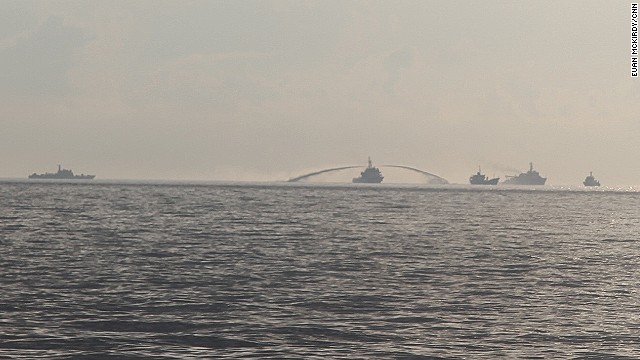
Approaching the area, dots on the horizon become ships, which then become a flotilla -- or perhaps more accurately two separate flotilla -- of both Chinese and Vietnamese commercial and coast guard vessels.
This mishmash of fishing and military vessels is all that remains of the flashpoint of a couple of weeks ago, and in a seemingly stage-crafted set of maneuvers dance around this expanse of utterly blue, clear sea.
Aggressive foghorns
It's a lively affair, alternating between angry, static-y rhetoric that informs the Chinese that they are in violation of international law, and aggressive foghorns and sirens, raising a cacophony on this otherwise peaceful, sunny afternoon.
"I've traveled out to these waters many times but recently the Chinese have been more aggressive towards the Vietnamese," says Hoang, captain of the support vessel. "I'm proud to protect Vietnam."
The dance is supervised by the respective country's coast guard vessels, who hopefully have too much sense to engage directly with each other. But hanging over the day's events is the knowledge that just hours before, a Chinese fishing vessel had rammed and sunk one of its Vietnamese counterparts.
No lives were lost in this incident but it is the first time that a boat has been sunk in this chapter of the often-acrimonious relationship between these two ideologically similar neighbors.
As the afternoon begins to wrap up, one of the larger Chinese coast-guard vessel homes in on our ship, horn blasting incoherently as it attempts a little maritime brinksmanship.
Nobody on board CG 8003 seems to be overly worried, although life jackets are donned as a fillip. Like a dog reaching the end of its chain, the Chinese vessel barks at us a few remaining times, before turning heel.
Off the starboard bow, two other Chinese vessels harry a smaller Vietnamese fishing boat, pushing it further from the center of this disagreement which, if left untended, could have dramatic consequences for these two countries, key players in a region that is -- perhaps belatedly -- starting to buck under the weight of Chinese hegemony.
 Euan McKirdy, CNN

China and a worthy condemnation

21:26 |
China’s illegal oil rig HD-981 deployment in the exclusive economic zone and continental shelf of Vietnam continues to face stiff opposition from the international community . Besides, the international media also criticized the actions causing serious damage by relavant forces to life and property of Vietnamese fishermen, especially the case when China rammed a fishing boat of Vietnam.
On May 26, Philippines President Benigno Aquino warned that the China’s blatant drilling rig HD-981 placement deeply in Vietnam’s exclusive economic zone and continental shelf bypassing opposition from Vietnam and the international community has revealed that Beijing may continue to have similar actions to destabilize the region. In an interview with the Financial Times (UK), President Aquino said that China triggered a dangerous move which may be beyond control and cause damage to the diplomatic relations and at risk of a coming conflict. Mr. Aquino also said at the interview that “China is " playing a dangerous game of brinkmanship and gunbost diplomacy”.
The president added he had received reports about the recent intrusion by a Chinese research ship near the Philippines’ coast at the same time considered that what happen to Vietnam eventually happen to the Philippines. He called on China to stop unilateral actions that contravened the 2002 Declaration of Conduct it had signed. He also urged the ASEAN member countries should have a stronger and clearer voice about how to resolve disputes in accordance with international law.
Meanwhile, international commentators asserted that unilateral actions by Beijing as a wrong step damaging China's reputation in the international arena. In terms of strategy, NHK asserted that with the deep placement of oil rig HD-981 in Vietnam’s exclusive economic zone and continental shelf, China may have to pay dearly for national supremacy and reputation when being a law unto itself. The same point of view, the commentator Brad Glosserman shared in an article on The National Interest newspaper (United States) that China's reputation has declined seriously because of being considered provoking factor into stability in the region.
On May 27, Japan has asked China for rein to avoid escalating tensions in the South China Sea. The appeal was made after China had rammed a Vietnamese fishing boat on May 26.
Speaking at a press conference in Tokyo, Chief Cabinet Secretary of Japan Yoshihide Suga said: “It is an extremely dangerous act which threaten human life”. He emphasized “it is important that all naitons work for the return to regional stability, act calmly, carefully in accordance with international law”. Meanwhile, Japanese Defense Minister Itsunori Onodera considered the act of ramming Vietnamese fishing boat as a “serious problem”. Speaking to reporters on the same day, Mr. Onodera pointed out that the matter need to be properly announced to the international community.
AFP news agency reported the incident happened in the May 26 afternoon of 26-5, Vietnamese fishing boat was surrounded among about 40 Chinese ships before being rammed. This French news agency quoted Japanese government spokesman Yoshihide Suga about ramming Vietnamese fishing boat act as an “extremely dangerous action”.
The BBC quoted Vice President of the Vietnam National Assembly Huynh Ngoc Son when he claimed China’s acts as “terrorist acts” against resistance fishermen to Vietnam.
Many major television channels like Bloomberg in the U.S., ABC in Australia, Reuters and The Guardian newspaper in England also criticized China’s act amid tense relations between Vietnam and China is worth being condemned.


Được tạo bởi Blogger.