
 Viet Nam Human Rights
HD981 drilling rig steams up the 13th Shangri-La Dialogue
22:41 |
The 13th Shangri-La meetings in Singapore provided the clearest evidence yet that the Asia-Pacific social order is in the midst of momentous changes. The status quo which has prevailed in the region for decades has now seemingly given way to an increasingly chaotic period that is deeply disconcerting, on a variety of levels.
Beijing’s decision to tow its HD981 giant oil-rig into Vietnam’s exclusive economic zone was an unexpected, bold, and invasive move that has triggered a concatenation of events no one could have envisioned.
At the dialogue, the three speeches that drew the greatest attention were those of Japanese Prime Minister Shinzo Abe, US Secretary of Defense Chuck Hagel, and Wang Guanzhong, PLA Deputy Chief of General Staff. While Abe and Hagel criticized Beijing for its apparent attempts to destabilize and change the regional status quo through coercive means, and promised to respond to these efforts, Wang accused Washington and Tokyo of trying to “instigate provocations against China” neglecting to recognize that Beijing’s claims over eighty percent over the entire maritime area is in fact at the root of regional instability.
That China is an emerging power gives its no right to impose its bogus sovereignty claims. Yet that is precisely what Beijing is doing in the South China Sea, or East Sea in our language. For those like me, who have observed China’s development with hope and enthusiasm, Beijing’s recent pattern of obdurate expansionism is massively disappointing and reason for true alarm.
Towing a one-billion dollar piece of drilling infrastructure to a remote location well within Vietnam’s exclusive economic zone requires not only capital and technical know-how, but also political arrogance and a patent disregard for international norms.
llegal encroachments of the sort we are now observing are nothing new. Beijing’s bloody and illegal seizures of islands in the Paracels in 1974 and in the Spratleys in 1988 resulted in the deaths of scores of Vietnamese and remain fresh in the Vietnamese psyche. These incidents, which followed a long history of tense relations between the two countries, have themselves been followed by two decades of unremitting harassment and abuse of innumerable Vietnamese fisherman.
These were the words used by Defense Minister General Phung Quang Thanh in a speech drew remarks among international observers and has been judged that the tenor the speech was appropriate, given the circumstances. The present is an exceedingly difficult period for Vietnam, its political leadership, and indeed the entire country’s population.
In the context of rapid changes it is understandable, going forward, we’ll face the decision of whether to seek international arbitration of the disputes with Beijing; a decision that Deputy Defence Minister Nguyen Chi Vinh recently told the South China Morning Post would hinge on China’s actions in the disputed maritime regions.
Clearly we are witnessing rapid changes in the social order. Of all parties to the dispute, Vietnam arguably finds ourself in the most difficult position of all. While the country must maintain minimally strong ties with Beijing, pathways to a resolution of the disputes can only be struck though a confident, prudent set of actions that send clear signals to the region and the world as to nature and bases of Vietnam’s claims. A strong, internally-united, and independent Vietnam may be the great hope for avoiding the further militarization and destabilization of the entire region./.


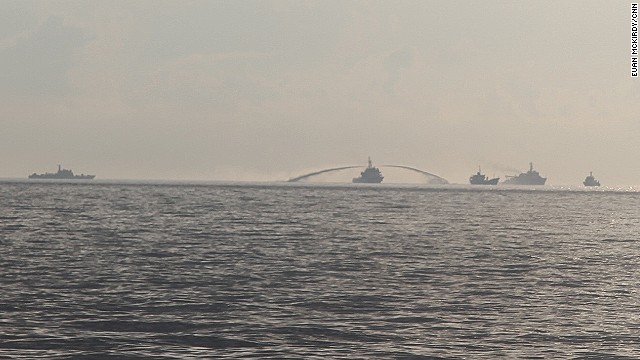 Vietnamese Coast Guard 8003, South China Sea (CNN)
-- It takes a long time to get to the middle of nowhere. For a
contingent of almost 40 reporters, hours of waiting both on land and
then at sea preceded a trip to one of the world's most hotly contested
areas of maritime real estate.

 Previous Article


