Next year the United Nations will commemorate its 75th anniversary. The General Assembly determined that all the UN's activities in 2020 shall be guided by the theme "The future we want, the United Nations we need: reaffirming our collective commitment to multilateralism".
In January the Secretariat plans1 to launch "the biggest-ever global conversation" on the role of global cooperation and to build a "global vision of 2045."
The UN Charter begins with the words: "We the Peoples". The Universal Declaration on Human Rights clearly states in article 21.1. that everyone has the right to take part in the government of their country, directly or through freely chosen representatives.
Thus, it should not come as a surprise that this right to participation will now also extend to the forthcoming "global conversation", as the UN has stated that anybody who wishes to, will be able to join.
At the same time, this is a bold statement in times of deep divides on not just the role of the UN but even more so about the role of citizens and civil society in shaping its affairs. It was only after contentious debates among member states, for instance, that a minor role for civil society was included in the formal resolution on UN75 adopted earlier this year.
The problem is well known.
Fifteen years ago, the Cardoso panel on the relations between the UN and civil society established by then Secretary-General Kofi Annan outlined2 the democratic deficit of global governance in clear terms.
They argued among other things that the UN should help "strengthen democracy for the twenty-first century" by emphasizing participatory democracy and deeper accountability of institutions to the global public.
Unfortunately, most member states had no appetite to look into this further. Despite all efforts to include non-state actors, the UN's democratic deficit remains critical and undermines the world organization's credibility.
The alternative People's Assembly that was held in parallel to the UN's summit on the Sustainable Development Goals in September in New York concluded3 that the "world is on fire" not least due to a dramatic "crisis of accountability and governance" that extends to the UN.
As well-intentioned it may be, the UN's global PR campaign that will be rolled out in the course of next year on the occasion of the 75th anniversary will not be able to alleviate the problem unless it leads to tangible institutional change.
From our point of view the UN is an indispensable centre for global deliberation, collaboration and action. The role of the UN as conscience keeper and upholder of universal norms and values remains steadfast.
However, the notion of multilateralism needs to evolve beyond purely intergovernmental engagement and open up to avenues for public and civil society participation. In itself this is a challenging task when "civic space" remains constrained for large swathes of the globe's population.4
A commitment to multilateralism at present should acknowledge more than ever that the UN's success depends on strong partnerships with major groups and stakeholders across the world.
As the Earth Summit 2012 stated, sustainable development requires their meaningful involvement and active participation in processes that contribute to decision-making, planning and implementation of policies and programmes at all levels.
A global civic participation campaign5 launched today by a broad alliance of citizens' initiatives, civil society groups and networks from across the world, jointly coordinated by Democracy Without Borders, Democracy International and CIVICUS: World Alliance for Citizen Participation, calls on the UN and its member states to go a step further.
The UN we need and the UN we want welcomes and seeks the input of "We the Peoples" in whose name it was established 75 years ago. Yet, there is no formal and well-structured UN instrument that enables individual citizens to influence the world organization's work and this has to change.
A global organization that wishes to leave no one behind – as member states pledged when they adopted the Agenda 2030 – needs to include everyone.
In fact, the General Assembly has repeatedly stated the "right to equitable participation of all, without any discrimination, in domestic and global decision-making". Informal consultations and public relations exercises to polish the UN's image are not enough. The UN needs to lead by example through innovations in participation.
Our campaign calls for the creation of a World Citizens' Initiative on the occasion of the UN's 75th anniversary. This new and innovative instrument will enable global citizens to submit proposals to the General Assembly or the Security Council if they manage to collect sufficient support from fellow citizens across the world within a specified time.
Similar participatory mechanisms already exist in many cities, regions and countries worldwide. A powerful example is the European Citizens' Initiative, the first transnational tool of modern direct democracy. It helps to understand how a World Citizens' Initiative could function.
Certainly, many technical details need to be discussed and political will mobilized. Still, we emphasize that a World Citizens' Initiative is feasible and that the UN and member states will be able to overcome all challenges if they are actually interested in the participation of "We the Peoples."
We are convinced that the UN, member states, civil society and global citizens alike will benefit from the direct link a World Citizens' Initiative will establish, and that its creation will represent an important step forward for the UN.
Clearly, a World Citizens' Initiative is a proposal that is complementary to other important efforts such as the inclusion of major groups and civil society in the UN's work or the establishment of a United Nations Parliamentary Assembly.
The World Citizens' Initiative is a proposal that is in line with the concept of people-centered multilateral cooperation in a spirit of global citizenship and it is in line with the Universal Declaration of Human Rights, among others6 . It may be a key element in the long-sought revitalization of the General Assembly.
We urge the UN and member states to study the proposal and to launch open and inclusive preparations for the creation of a UN World Citizens' Initiative. Civil society groups and individual citizens are invited to join the campaign and help us build the necessary political momentum and public pressure for transformation.
Every day in developing countries it is estimated that 20,000 girls under the age of 18 give birth. This amounts to 7.3 million births a year.
Complications from pregnancy and childbirth are still the leading cause of death among adolescent girls, according to the United Nations Population Fund (UNFPA) statistics.
Let us be heard
Born long after the Cairo Promise, the 18-year-old Michelle Simon and the 19-year-old Botho Mahlunge both youth representatives from Botswana, lament that years later a world where girls can enrol and stay in school is far from the lived reality for millions of adolescents across the globe.
"When I was 13 years old I started to see the connection between girls getting pregnant and dropping out of school. "These girls were very bright but when they left school they never returned.
I started to talk about preventing these pregnancies at that young age," Simon tells IPS.
Simon says that 25 years after the promise, "it is very sad because those who should be protecting us have failed us. Parents cannot even close the gap between them and their adolescent".
She argues that parents have abdicated their responsibility to the education system and the entire society. "But where is the parent's responsibility towards adolescent health?" she asks.
Simon says that in this era of technology and information, adolescent health should not be the problem area that it is. "We cannot hide behind culture and say that ours is a conservative society.
Culture should reflect problems
"Culture evolves and it must so that it can reflect the problems we are facing," she says.
Mahlunge says that failure to educate our young people on sexuality "is the reason so many girls are getting pregnant and infected with HIV."
She says the continued exclusion of young people in rural areas from sexual and reproductive health and rights discussion is also to blame for the prevailing state of affairs.
"Young people in rural areas are completely vulnerable. They are so far removed from the little information and services available to young people in urban areas," Mahlunge observes.
We need sexual health education
Denis Otundo from the Network for Adolescent and Youth of Africa says that the ICPD25 conference has a lot in store to offer adolescents.
He notes that the stigma attached to providing adolescents with comprehensive sexuality education in many African countries is unfounded.
"This Summit is very clear on what needs to be done. As early as at the age of 15 years, adolescents should start receiving information on sexuality. The focus is to provide the right information, at the right time so that adolescents can make the right decisions," he says.
Otundo says that this information includes life skills "on how to say no to sex because this is part of promoting adolescent health. It is also about training them on identifying all forms of violence, teaching them about available channels to report violence, and how to report".
Experts at UNFPA argue that if laws support access to adolescent sexual and reproductive health rights, this could delay early sexual debut because such rights encourage and enable young people to make sound decisions.
He says that when young people lack access to proper information, they turn to fellow adolescents for information.
Invest in young people says the Asian Population and Development Association
Dr Osamu Kusumoto from the Asian Population and Development Association (APDA) says that the capacity of countries to accelerate and achieve ICPD25 commitments is dependent on the extent to which countries invest in their young people.
"Unplanned pregnancies are a big problem in developing countries. When you have a large population of young people pregnant while they should be in school, this is a problem for the economy too," he says.
In Kenya alone, UNFPA statistics show that many young girls are likely to have repeated pregnancies.
As many as one in five girls give birth before the age of 18 years, even worse, as a majority of then will get married. Girls between 15 to 19 years are particularly at risk of acquiring HIV.
Kusumoto says that interventions must address young people's most pressing problems. In this way, they can stay in school and acquire the skills needed to participate in the economy.
Young people are the heart of this Summit
"Adolescents are at the heart of the Summit. All the commitments that have been made, in one way or another, touch on adolescents," says Otundo.
He says that adolescents are the most affected by sexual and gender-based violence, and harmful practices including female genital mutilation and child marriages.
Among the private sector partners who have committed funds to deliver the Cairo promise include Plan International who will allocate $500 million to improve the sexual and reproductive health and rights of girls and adolescents by 2025.
"I speak out about unwanted pregnancies and violence against young people. I also speak out about the need to stay in school because I believe this is what we need to accelerate the promise made to us even before we were born," Simon says.
Botho encourages young people wherever they may be "to engage and to dialogue. If you see an opportunity to hold government accountable, do not hold back."
This year the Worldwide Web is thirty years old. For the first time since 1435, a citizen from Brazil could exchange their views and information with another in Finland.
The Internet, the communications infrastructure for the Web is a little older. It was developed from the ARPANET, a US Defense Department project under the Advanced Research Projects Agency; the military designing it to decentralize communications in the case of a military attack.
That network enabled scientists to communicate over email in universities. Then in 1989 Tim Berners-Lee at CERN in Switzerland invented the Hyperlink and the Worldwide Web (the Web) rapidly moved from scientists automating information sharing between universities and research institutions to the first Websites now available to the general public.
In 2002 the first social media sites began as specialised websites. LinkedIn launched in 2003 then FaceBook in 2004, Twitter in 2006, Instagram in 2010 and so on…
My generation regarded the arrival of the Web as a great prospect for democracy. We come from the Gutenberg era, an era that in 1435 changed the world. From manuscripts drafted by monks to be read by a few people in monasteries, the invention of reusable movable type meant that in just 20 years already eight million copies of printed books went all across Europe.
Among many other things it also meant the creation of information. People who heretofore had merely a scant horizon beyond their immediate surroundings, could suddenly access information about their country, and even the entire world. The first newspaper was printed in Strasbourg in 1605. From then until 1989, the world was filled with information.
Information had a very serious limit. It was a vertical structure. Just a few people sent news to a large number of recipients; there was little feedback. It wasn't participatory, it required large startup investments, it was easily used by economic and political powers.
In the Third World, the media system was part of the State. In 1976, 88% of World news flows emanated from just three countries: the US, the UK and France. International news agencies based in these three countries included Associated Press (AP), United Press International (UPI), Reuters and Agence France Press (AFP).
The world's media were dependent on their news services. Some alternative news agencies, like Inter Press Services, were able to put a dent in their monopoly. But what this Western media published, by and large was a biased window on the world.
Then came the Internet, and with it, came horizontal communication. Every receiver was also a sender. For the first time since 1435, media were no longer the only window on the world. Like-minded people could take part in social, cultural and economic interactions.
This change was evident in the United Nations Woman's World Conference in Beijing, 1995. Women created networks prior to the conference, and came with a common plan of action. Governments were not so prepared, so the Declaration of Beijing was a turning point, one which was entirely unlike the bland declarations from the previous four World Conferences.
Another good example is the campaign to eliminate anti-personnel landmines, started by the Canadian activist Jody Williams in 1992. This soon blossomed into a large coalition of Non-Governmental Organizations from more than 100 countries.
Under mounting pressure Norway decided to introduce the issue to the UN, where the US, China, and other manufacturers of landmines like the USSR, tried to block the debate, declaring that they would vote against it.
Roberto Savio
The activists did not care, and 128 countries adopted the Mine Ban Treaty in 1997 with the US, China and the USSR voting against. A vast global movement was more powerful than the traditional role of the Security Council. The Internet had become the tool to create world coalitions.
Those are just two examples of how far the Internet could change the traditional system of Westphalian state sovereignty as defined at the Conference of Westphalia in 1648. The Internet spanned national frontiers to bring on a new era.
Let's say, for the sake of symbolism, that the Internet brought us from the Gutenberg Era, to the Zuckerberg Era, to cite the inventor of Facebook and a leading instance of what went wrong with this medium.
The Internet came upon us with an unprecedented force. It took 38 years for the radio to reach 50 million people: television took 13 years; and the Web just four years. It had a billion users in 2005, two billion in 2011, and it now has three and a half billion users, three billion of those using social media.
So the two traditional pillars of power, the political system and the economic system, also had to learn how to use the Internet. The US provides a good example. All of American media (national and regional publications) involves printing 50 million copies daily.
Quality newspapers — both the conservative broadsheets like the Wall Street Journal, and progressive ones like the Washington Post or the New York Times — together print ten million copies a day. Trump has sixty three million followers on Twitter; they read Trump's tweets but don't buy newspapers.
The Web has had two unforeseen developments. One was the dramatic reinforcement of the consumer society. Today advertising budgets are ten times larger than budgets for education, and education only lasts a few years compared with a lifetime of advertisement.
With the development of social networks, people — now more consumers than citizens — have become objects for marketing goods and services, and recently also for political campaigns. All systems of information and communications extract our personal data, selling us on as consumers.
Now the TV can see us while we watch it. Smartphones have become microphones that listen in on our conversations. The notion of privacy is gone. If we could access our data, we would find out that we are followed every minute of the day, even into our bedrooms.
Secret algorithms form profiles of each and every one of us. Based on these profiles platforms provide us with the news, the products, and the people that these algorithms believe we will like, thus insulating us in our own bubbles.
Artificial intelligence learns from the data that it accumulates. China, with 1.35 billion people, will provide its researchers with more data than Europe and United States together. The Internet has given birth to a digital extractive economy, where the raw material is no longer minerals, but we humans.
The other development that went awry is that the digital extractive economy has created unprecedented wealth.
Amazon CEO Jeff Bezos was recently divorced from his wife. In the settlement she received 36 billion dollars yet Bezos remains among the 10 richest people in the world. This is just one story from an increasingly sad reality of social injustice, where 80 of the world's richest persons hold the same wealth as nearly three billion poor people.
A new sector is evolving, the "surveillance capitalism" sector, where money is made not from the production of good and services, but from data extracted from people.
This new system exploits humans to give to the owners of this technology, a concentration of wealth, knowledge and power without precedent in history. The ability to develop facial recognition and other surveillance instruments no longer lies in the realms of science fiction.
The Chinese government has already given every citizen a digital number, where all their ‘good' and ‘bad' behaviours converge. If a citizen goes below a level, their children will not be allowed to go to a good school, and the citizen themselves, though they may still be able to travel by train, won't have access to planes.
These technologies will soon be in use all over the planet. London town now has 627,000 surveillance cameras, one for every fourteen citizens; in Beijing it's one for every seven. A study conducted by The Rand Corporation estimates that by 2050, Europe too would also have one camera for every seven citizens.
The interrelationship between democracy and the Internet is now creating a belated awareness in the political system. The European Parliament has just released a study, about the negative impact of the Internet. These impacts are:
Internet Addiction There is unanimity among doctors and sociologists that a new generation is coming, one which is very different from the previous one. Over 90% of those aged 15-24 uses the Internet, as against 11% for those over 55. Young people spend 21 hours per week on the PC, and 18 hours on a smart phone. This leaves little time for social and cultural interaction. 4.4% of European adolescents now show pathological Internet use "that affects their lives and health". The American Academy of Psychology has officially included Internet Addiction as a new ailment. Magnetic resonance studies of those with Internet Addiction Disorder (IAD) show that they exhibit the same brain structure alterations as those who suffer from drug or alcohol addiction.
Harming cognitive development A particular warning is given about children under two years of age. More than 20 minutes a day of screen use reduces some of their neural development. People pushed to isolation tend to develop symptoms of distress, anger, loss of control, social withdrawal, familial conflicts, and an inability to act in real life. Internet users in tests were faster than non-users at finding data, but they were less able to retain data.
Information Overload The condition of having too much information hampers the ability to understand an issue, or to make effective decisions, an important issue for managers, consumers, and social media users. According to Microsoft, attention span for a title has gone from 12 seconds in 2000 down to 8 seconds in 2016. The attention span for reading has gone from 12 minutes to 8 minutes. Two new terms can be used: one, the ‘popping brain', describes a brain less adept to adapt to a slower pace of real life and then there is ‘Neuroplasticity'; i.e. the ability to alter one's behaviour after a new experience. Frequent immersion in virtual worlds can reduce neuroplasticity and also make it more difficult to adapt to the slower pace of real life. The need to compete in speed between social media channels is well known. For example Amazon estimates that one second of performance delay would cost 1.16 billion losses per year in sales.
Harmful effects in knowledge and belief The fact that social media deliberately tends to gather together users with similar views, tastes and habits, is fragmenting society in a negative way for democracy, resulting in closed systems that don't allow for alternative viewpoints. Adolescents no longer discuss significant subjects. They go to their virtual world, and if they come across somebody from another group, they tend to insult each other. The Internet is full of fake news and misleading information, and users have great difficulty distinguishing accurate from inaccurate information. Echo chambers appear to be far more pervasive, and may unite those with more extreme and partisan political and ideological positions, therefore undermining possibilities for civil discourse and tolerance, supporting radicalization.
Harming public/private boundaries. The Internet blurs the distinction between the private and the public. Private life becomes public. This is especially negative for teenagers who lose the concept of privacy, for example by sending private photos across the Internet. One important observation is that teenagers now get their sexual education from pornography, where women are always an object to satisfy men's sexual phantasies. This is in turn creating a lack of respect for women, and a new generation that risk, for new reasons, returning to a patriarchal society. Group violations of teenage girls are clearly a result of this trend.
Harming social relationships The Internet is clearly a powerful instrument to create new communities. However, when used negatively, it can also damage communities, because of the migration to Internet of many human activities such as shopping, commerce, socialising, leisure, professional activities and personal interaction. That migration creates impoverished communication, incivility and a lack of trust and commitment.
Harming democracy The Internet has been a powerful tool for participation, and therefore for democracy. However the study notes with concern that a growing number of activities are also harmful to democracy. These include: a) The incivility of many online political discourses, b) Political and ideological polarisation, uniquely possible using the Internet. c) Misinformation, and, in particular, fake news, d) Voter manipulations through profiling based on harvested social media information. We all know what happened in the US elections with Cambridge Analytica data, gathered by Facebook, and how thousands of false web users and bots now heavily interfere in elections.
We should add to this study some other considerations. The first is that finance now is now also run by algorithms. The algorithms do not only decide when to sell or buy shares, but now also decide where to invest.
The Exchange-Traded Funds (ETFs) last month reached 14,400 billion dollars in trades, more than that traded by humans. This trend will continue with the development of artificial intelligence and soon finance will become even more dehumanized. Even when Internet users invest themselves they too will be directed by machines and algorithms.
A second consideration is that young people read less and less. Reading a book is very different to scrolling a screen. We are experiencing a progressive reduction in levels of culture. It's not uncommon to have university students that make grammar and spelling mistakes.
Let us remember that when the Internet was still new, its proponents told us: it is not important to know, rather it is important to know how to find. We are more and more dependent on search engines, learning less and less, and we are unable to connect that data in a personal holistic logical system.
There is clearly a need for regulation to reduce the negative aspects of the Internet and to reinforce positive values. The owners of social media platforms are now under increased scrutiny so they have taken the road of self-regulation.
Twitter, for instance, has decided that it cannot be used for political purposes. Zuckerberg is an exponent of market myths telling us that good news will automatically prevail over fake news. Except that platforms help users to read and find only what they like, to maintain our attention, providing us what is striking, unusual and provocative. This is not a free market.
The Zuckerberg era is clearly creating an entirely different generation, very different from the generations of the Gutenberg era. This raises many questions, from privacy to freedom of expression (now in private hands), from who will regulate, what to regulate and how.
A five year-old child is now very different from a Gutenberg five year-old. We are in a period of transition. The meaning of democracy is changing. International relations are moving away from the search for common values via multilateralism, to a tide of nationalist, xenophobic and selfish views of the world.
Terms like peace, cooperation, accountability, participation and transparency are becoming outdated. What is clear is that the present system is no longer sustainable. Policies disappear from debate, now referred to only as ‘politics'. Vision and paradigms are getting scarce.
Over and above all of this the threat of climate change is looming; yet last year toxic emissions from the five largest countries increased by 5%. Young people are largely absent from political institutions as is shown by the vote on Brexit where only 23% of the 18-25 age group participated.
At this very moment we have large demonstrations in thirteen countries all over the world. In those streets young people do participate, frequently demonstrating rage, frustration and violence. If we cannot bring back horizontal communication to the Internet and we do not free it from the commercial fracturing of young people, the future is hardly rosy.
Yet as the marches against Climate Change clearly demonstrate, if young people want to change the world, values and vision will return. It is evident that the Internet can be a very powerful tool. But who will redress these failings? Will the Internet become a tool for participation? How will this be done?
These are questions that political institutions, if they really care for democracy, must address as soon as possible. The Zuckerberg era must make this choice now, in a few years time it will already be too late…
With 88.2% of votes, the National Assembly’s deputies passed a resolution on socio-economic development by 2020 on November 11 in Ha Noi.
The resolution targets to stabilize the macro-economy; control inflation; raise productivity, quality, and efficiency, self-reliance, and competitiveness of the economy; perfect institutions; generate a fair investment and business environment; accelerate the economic restructuring in combination with growth modal; accelerate the progress of national important projects; uphold the role of key economic regions and big urban areas.
Key preset norms included a 6.8% GDP; a CPI of under 4% ; total export value growth rate of 7%; a trade deficit of under 3%; a total social development investment of 33-34% of GDP, a reduction of 1-1.5% in household poverty (based on multilateral poverty lines) and a reduction of 4% in household poverty rates in poor districts; an unemployment of under 4% in urban areas; 65% of laborers trained; 25% of trained laborers with diplomats, certificates; 28 hospital beds per 10,000 residents (excluding those in communal health clinics); a health insurance coverage of 90.7% ; 90% of industrial and export processing zones with standard centralized waste water treatment systems; and a forest coverage of 42%.
Regarding key tasks and solutions for 2020, the National Assembly approved of the tasks and solutions of the Government, the Supreme People’s Court, and the Supereme People’s Procuracy.
The NA tasked the Government and relevant agencies to implement the tasks and solutions; continue to build and perfect the legal system in response to integration, macro-economic stabilization, inflation curbing, safeguarding of big balances.
The NA asked ministries, agencies, and localities to mobilize and utilize rsources; perfect infrastructure; develop urban areas; speed up progress of the North-South Express and site clearance of Long Thanh international airport.
The legislative body also noticed that the Government and relevant agencies allocate resources; take active step to respond to climate change; prevent natural resources; manage natural resources; protect the environment; combat corruption and wastefulness; maintain socio-political stability; and prevent corruption./.
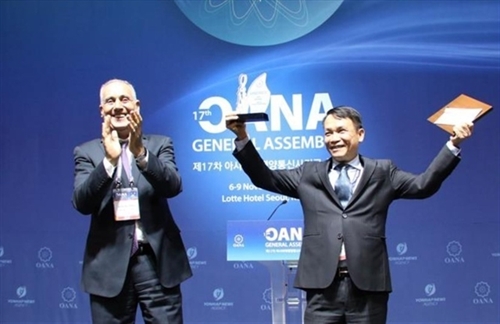
General Director of the Vietnam News Agency (VNA) Nguyen Duc Loi on November 8 highlighted the need to win public trust in the fight against fake news while addressing the 17th General Assembly of the Organization of Asia-Pacific News Agency (OANA) held in the Republic of Korea (RoK) from November 6-9.
Vietnam News Agency (VNA) General Director Nguyen Duc Loi (right) received an Organization of Asia-Pacific News Agencies (OANA) award from outgoing OANA President Aslan Aslanov at the 17th OANA General Assembly in Seoul on November 8. The Vietnam News Agency and Xinhua News Agency (China) shared first prize of the OANA Award for Excellence in News Agency Quality for their Chatbot apps on e-newspaper VietnamPlus and AI Media Brain__Photo: VNA
In his presentation, he said fake news continues to be a major concern for news agencies and media outlets around the world - and the VNA is no exception.
Fake news has come in a more sophisticated manner as technology develops and cost reduces, he said.
“Experts have predicted that as artificial intelligence is applied widely in the process of producing media content, fake news made by machines will also be born with overwhelming quantity,” Loi noted.
He called on journalists to act instead of waiting for agencies to promulgate new laws, for technology firms to change algorithms, or for users to become better at distinguishing fake news, as they bear heavy responsibility for society.
Loi cited many studies on the future of the press showing that the goal of the press now is not to attract public attention any longer, but to regain their trust.
“How to rebuild public trust in high quality press content is always a big question for managers, news agencies, editorial offices and journalists themselves,” he said.
According to the VNA leader, to combat fake news, his agency has worked hard to interact with leaders through the Chatbot software that won the OANA Award for Excellence in News Agency Quality in 2018.
He suggested news agencies act to cope with information that incites hatred and racial discrimination or distorts the truth to harm individuals, organizations and countries, apart from pouring more investment into technology to produce high-quality news.
In his remarks, Cho Sung-boo, President and CEO of the host country’s Yonhap News Agency, said global news agencies are facing unprecedented challenges, and they should turn these into new opportunities.
He also called on news agencies to continuously make new products in new forms, and revamp the ways they deliver them.
At a working session on Friday, OANA member news agencies elected Yonhap as OANA Chair for 2019-2022. This is the first time the news agency has held the position since its establishment in 1980.
News agencies from Azerbaijan (AZERTAC), Russia (TASS), Turkey (Anadolu) and China (Xinhua) will assume the post of OANA Vice Chairs.
The 17th General Assembly also elected the OANA Executive Board with 13 news agencies, the Technical Committee comprising of seven news agencies and a four-member ethics committee for 2019-2022. The VNA again won a seat on the OANA Executive Board.
The WAFA News Agency of Palestine has become an observer of the organization.
OANA members agreed to adopt the minutes amending the OANA Statute, which was approved at the 44th Executive Board Meeting in Hanoi in April.
In the Seoul Declaration adopted at the meeting, the agencies pointed out challenges they are facing amidst the development of technology and the spread of fake news.
On this occasion, the 45th and 46th meetings of the OANA Executive Board were also held in Seoul.
The Executive Board elected Lee Dong-min, a journalist of Yonhap, as OANA Secretary General.
Within the framework of the 17th General Assembly, the VNA and Xinhua, first-prize winners of the OANA Award for Excellence in News Agency Quality as announced at the 44th Executive Board Meeting, were honored.
On the sidelines of the event, VNA General Director Loi met with Yonhap President and CEO Cho, who said he highly valued the fruitful relations between the two news agencies.
The host expressed his hope for more support and co-operation from the VNA in the future.
Loi said the relationship with Yonhap was one of the most successful, effective and diverse ties between the VNA and its partners.
The VNA’s VNEWS TV Channel and e-newspaper were using effectively TV news of Yonhap, he said, calling on the agency to produce and share news of more diverse content in both Korean and Vietnamese with the VNA.
OANA now has 44 member news agencies from 35 countries in the region. The agencies are responsible for two-thirds of information produced throughout the world. Every day, they publish around 200 news stories, photos and video clips on the OANA website http://www.oananews.org.
Since joining the OANA in 1969, the VNA has proven itself as one of the active members of the organization. It is now a member of the OANA Executive Board, and hosted the OANA Executive Board Meetings in 1989, 1999, 2005 and 2019, actively contributing to completing the organization’s targets.
Both child marriages and incestuous marriages among ethnic
minority groups have been a long-term problem for local
administrations in Nghệ An and Quảng Bình, although they have taken measures to
curb them over the years. Data from the Ethnic Minority
Committee in Nghệ An Province showed there were 902 child couples
married from 2014-18, some even as young as 12.
Huổi Tụ Commune
is estimated to have 87 child-marriage couples alone, of which 34
were married under the age of 16.
Statistics from Quảng
Bình Province revealed that 186 child marriages and seven incestuous
marriages took place from 2014-18.
Nguyễn Lương Cường, head
of the Dissemination Office under Quảng Bình Province’s Ethnic Minority
Committee, said the biggest problem was backward traditional practices.
The custom of “stealing
a wife” among the H’Mông ethnic minority group was blamed as one of the
causes for child marriages, said Vì Quang Bảnh, a member of judicial staff
in Tam Hợp Commune, Nghệ An Province.
Cướp vợ (stealing a wife)
is a special H’Mông custom. When a man loves a woman, he must ‘steal’
her on her darkest night and imprison her without food for 2-3
days. If the woman accepts his proposal, he will then ask her family
for permission.
Lack of awareness
among local people was also to blame for the situation, Cường said.
According to UNICEF,
child marriage was a violation of children's rights, and had a negative
impact on physical growth, health, mental and emotional development, and
education opportunities.
It also
affected society as a whole since child marriages reinforced a cycle
of poverty and perpetuated gender discrimination, illiteracy and
malnutrition as well as high infant and maternal mortality rates.
Incest could increase
inherited diseases, as can advanced maternal age at conception, which
increased chromosomal trisomies such as Down's syndrome, a report by the
World Health Organisation said.
Solutions
Both provinces have
taken measures following a Government project titled “Reducing child
marriage and consanguineous marriage in ethnic-minority areas in 2015-25” to
fix the situation.
The goal of the project
is to reduce the number of child marriages by 2-3 per cent each year, and
the number of consanguineous marriages by 4-5 per cent each year. By 2025,
this would basically solve the situation.
However, the project had
been less effective than expected, said Lô Thanh Nhất, vice chairman of
Tương Dương District's People’s Committee in Nghệ An Province.
Dissemination was still
the major solution, he added.
There were no
sanctions to deal with violations so little impact had been made, he said.
Cường, head of
the Dissemination Office under Quảng Bình Province’s Ethnic Minority
Committee, said the province had already set up a steering committee to implement
the project.
Cường suggested
authorised agencies should consider solutions to improve the incomes
of ethnic minority people.
"I think it is one
of the best solutions because child marriages and incestuous marriages were
mainly reported in poor areas," he said./.
A Vietnamese Australian man and five accomplices were sentenced
to various prison terms Monday for planning to overthrow the Vietnamese
government.
A Ho Chi
Minh City court sentenced Chau Van Kham, 70, to 12 years in jail on the charge
of "terrorism to oppose the people's administration." He will be
deported as soon as he finishes his jail term.
His
accomplices Nguyen Van Vien and Tran Van Quyen were jailed for 11 and 10 years
respectively for the same offence. Three others were found guilty of
"forging seals and/or documents of agencies and/or organizations" and
received sentences ranging from three to four years in jail.
According
to the indictment, Kham settled down in Australia and joined Viet Tan, an
organization Vietnam has classified as a terrorist group, in 2010. He held
senior positions in the organization led by U.S.-based Do Hoang Diem. The
organization works to eliminate the leadership of the Communist Party of
Vietnam and to overthrow the Vietnamese government.
Kham was
assigned by Diem to recruit and train new members, enter Vietnam to provide
financial support for the operation of Viet Tan and provoke demonstrations, the
court heard.
At the
end of 2018, Kham moved from Australia to Cambodia and used fake documents to
enter Vietnam.
He rented
a hotel in Ho Chi Minh City to live there and propagate principles of the
organization for new members. Among the people he recruited were Vien, a GrabBike
driver, and Quyen, a camera repairer.
Vien and
Quyen were taken to Cambodia to attend a training class conducted by Diem and
the Viet Tan organization. They received $600-900 from the group.
They
hired some people to make fake documents and papers for some members of the
organization to apply for local jobs, and were caught by police in the process.
Kham was
arrested in Ho Chi Minh City in January this year.
Investigators
under the Ministry of Public Security are expanding the investigation against
Diem and other accomplices who are living in the U.S.
Under the
Vietnamese law, the maximum penalty for conducting activities to overthrow the
government is death./.
People from ethnic minority groups in Quang Ninh have health check-ups.
The percentage of disadvantaged hamlets and communes in eight northeastern provinces has reduced 3 to 4 percent per year since 2016, heard a workshop held in Cao Bang province on November 8 to review the implementation Programme 135 for 2016-2020 period.
The programme has been implemented in 683 communes (32 percent of total communes nationwide) in eight provinces of the northeastern area, namely Quang Ninh, Ha Giang, Cao Bang, Bac Kan, Tuyen Quang, Thai Nguyen, Lang Son and Bac Giang.
It has mobilised more than 7.3 trillion VND (nearly 315 million USD) from the State and provincial budget and achieved positive results, contributing to hunger elimination, poverty reduction and improving the lives of ethnic minority people.
Income per capita of local people has increased by 1.5 to 2 times. Transport infrastructure, health care and education facilities have been upgraded. People in all the disadvantaged villages have received new plant and animal breeds.
Addressing the event, Y Thong, Deputy Minister and Vice Chairman of the Committee for Ethnic Minority Affairs, said the workshop aimed to review the efficiency of the programme and share exemplary poverty reduction models, which serves as a foundation to propose a framework for the national target programme on socio-economic development in ethnic minority and mountainous area in 2021-20.
He said the programme “should be implemented in an easy, simple way and take advantage of the community along with empowering authorities at different levels.”
Participants said the national target programme must focus on improving people’s lives, offer them stable jobs and ensure income per capita will double by 2025 compared to 2020. Ethnic minority and mountainous areas should be assisted to apply technology in production.
The Government’s Programme 135 was launched in 1999 under the Prime Minister’s decision 135/1998/QD-TTg dated July 31, 1998, with the aim of improving living conditions for rural residents with a particular focus on ethnic minority communities./.

 Viet Nam Human Rights

.png)


 Previous Article


