Global Poverty Soars — As Incomes of World’s Billionaires Hit New Highs

21:07 |

 The phenomenal rise in extreme poverty -– for the first time in 20 years -- has been accompanied by an upsurge in the incomes of the world's billionaires and the super-rich.

The paradox of poverty amidst plenty is being blamed largely on the coronavirus pandemic which has driven millions, mostly in the developing world, into a state of perpetual poverty.

As the United Nations commemorates International Day for the Eradication of Poverty, the rich are getting richer and the poor poorer-- which may also reflect the realities of widespread economic inequalities worldwide.

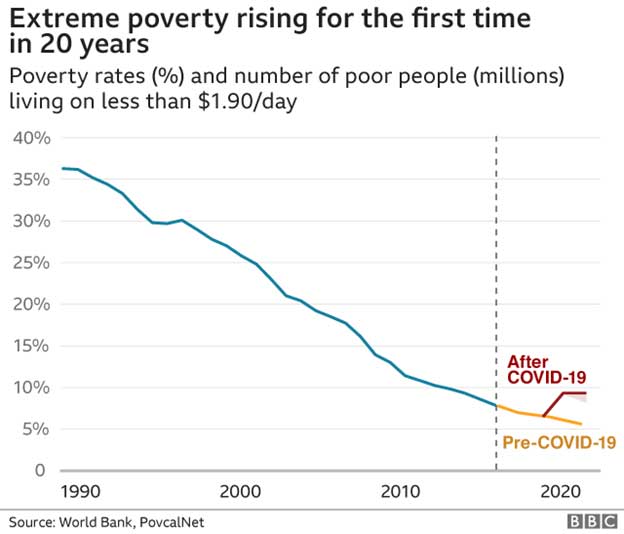
A World Bank report last week said extreme poverty is set to rise this year, for the first time in more than two decades, while the impact of the spreading virus is expected to push up to 115 million people into poverty.

The pandemic, which is also compounding the forces of conflict and climate change, has already been slowing poverty reduction, the World Bank said.

By 2021, as many as 150 million people could be living in extreme poverty.

In contrast, the wealth of the world's billionaires reached a new record high in the middle of the pandemic, primarily as "a rebound in tech stocks boosting the fortunes of the global elite", according to a report released last week by UBS Global Wealth Management and PwC Switzerland.

Providing a sheaf of statistics, the report said total wealth held by billionaires reached $10.2 trillion last July, described as "a new high", compared with $8.9 trillion in 2017.

The number of billionaires worldwide has been estimated at 2,189, up from 2,158 in 2017.

The rising earnings were mostly from three sectors, including tech, health care and industry—a trend accelerated by the pandemic.

But the study also says the rise in billionaires has led to greater philanthropy, with some 209 billionaires pledging $7.2 billion in donations.
At the other end of the scale, billionaires have seen their fortunes hit record highs during the pandemic, with top executives from technology and industry earning the most.

The world's richest saw their wealth climb 27.5% to $10.2tn (£7.9tn) from April to July this year, according to a report from Swiss bank UBS.

Pooja Rangaprasad, Director, Policy and Advocacy, Financing for Development (FfD) at the Rome-based Society for International Development (SID), told IPS "philanthropy or charity is not a substitute for systemic solutions".

Many developing countries are already on the brink of debt crises which is further exacerbated by a broken international tax system that allows wealthy corporations and individuals to pay little to no taxes, she pointed out.

"Unless global economic solutions are prioritised to ensure developing countries have the fiscal space to respond to the crisis, the consequences will be devastating with millions being pushed back into extreme poverty," she warned.

Governments need to urgently agree on systemic solutions such as debt cancellations, a binding and multilateral UN framework for debt crisis resolution that addresses unsustainable and illegitimate debt and a UN tax convention to fix loopholes in the international tax system, argued Rangaprasad.

Professor Kunal Sen, Director of UN University World Institute for Development Economics Research (UNU-WIDER), told IPS the pandemic is going to push millions of households into poverty, all around the developing world.

"The challenge for the international community is to channelise additional resources through Official Development Assistance (ODA) to low income countries, where global poverty is concentrated".

"The UN can play an important role in mobilizing resources for financing the efforts of the member states to counter the effects of the pandemic on the poor and vulnerable in their own countries", said Dr Sen, who is also a professor of development economics at the Global Development Institute, University of Manchester, UK.

The projected rise in poverty has also undermined one of the UN's 17 Sustainable Development Goals (SDGs) which had targeted the eradication of extreme poverty and hunger by 2030.

According to the World Bank, "extreme poverty" is defined as living on less than $1.90 a day. The projected increase in poverty would be the first since 1998, when the Asian financial crisis shook the global economy.

Before the pandemic struck, the extreme poverty rate was expected to drop to 7.9% in 2020. But now it is likely to affect between 9.1% and 9.4% of the world's population this year, according to the bank's biennial ‘Poverty and Shared Prosperity Report'.

"The pandemic and global recession may cause over 1.4% of the world's population to fall into extreme poverty," said World Bank Group president David Malpass.

He said that to reverse this "serious setback", countries would need to prepare for a different economy post-Covid, by allowing capital, labour, skills and innovation to move into new businesses and sectors.

Malpass said World Bank support would be available to developing countries "as they work toward a sustainable and inclusive recovery", with grants and low-interest loans worth $160 billion to help more than 100 poorer countries tackle the crisis.

Ben Phillips, author of ‘How to Fight Inequality', told IPS the concentration of wealth amongst a handful of oligarchs, and the spread of impoverishment to hundreds of millions more people, are not the disconnected coincidences that the super-rich claim, but are two sides of the same bad penny.

He said COVID-19 has not created obscene inequality, but it has supercharged it. In this systemic crisis, the healing impact of philanthropy will be no greater than a novelty sticking plaster on a gaping wound.

As the Pope, the UN Secretary-General, the President of Ireland and the Prime Minister of New Zealand have all pointed out, there is only one non-disastrous way out of this, and that is a rebalancing of economies to serve ordinary people, he noted.

"That is absolutely doable – indeed, we've done it before – but markets cannot self-correct, and elites never bestow a fair economy from on high. Only pressure from ordinary people can win an economy that is humane and safe," declared Phillips.

Dereje Alemayehu, Executive Coordinator, Global Alliance for Tax Justice, told IPS inequality is rising in every country; so also, is the income of billionaires. These are causally linked.

"Multinationals and the wealthy do not pay their share of taxes, thus depriving countries the public revenue needed to address inequality."

Furthermore, he said, the prevailing international financial architecture denies developing countries their right to tax their share in global profit of multinationals. To adequately address inequality, national governments should introduce progress and redistributive tax systems.

But his would not be enough.

"Developing countries should also reclaim their taxing rights on global profit. For this, a UN led intergovernmental process, in which member states participate on an equal footing, should be established to pave the way for the reform international tax rules and standards," said Alemayehu, who is also Senior Advisor - Economic Policy at Tax Justice Network Africa.

ASEM striving to achieve 'twin goals' of 'not leaving anyone and any women behind

21:47 |
                                  Deputy Foreign Minister To Anh Dung speaks at the dialogue

Nearly 130 delegates from 41 ASEM member countries and seven international and regional organisations have attended the Asia-Europe Meeting (ASEM) High-level Dialogue on Promoting Women’s Economic Empowerment amid the COVID-19 Pandemic which was an initiative proposed by Vietnam and was strongly supported by ASEM members.
The dialogue has opened on October 12 in the form of video conference.

Co-hosted by the Ministries of Foreign Affairs and Labour, Invalids, and Social Affairs, the dialogue was an initiative proposed by Vietnam and was strongly supported by ASEM members.

Eight countries namely Australia, China, Denmark, Finland, Indonesia, Italy, Japan, and Norway co-sponsored and worked together to implement the initiative.

It is one of the most important activities of ASEM in 2020 and is also the first practical activity to implement the direction of ASEM Foreign Ministers on responding to COVID-19 adopted in the Declaration on July 9, 2020.

The two-day dialogue focuses on discussing the impacts of COVID-19 on women’s economic activities, thus proposing measures to strengthen Asia-Europe cooperation to improve women’s economic power in current economic recovery efforts.

In his opening speech, Deputy Foreign Minister To Anh Dung affirmed that 2020 is a landmark year in realising the goal of gender equality and women’s empowerment and marks the 25th year of implementing the Beijing Declaration and Platform for Action to promote gender equality, the 20th anniversary of the adoption of UN Security Council Resolution 1325 (2000) on Women, Peace and Security, and five years of implementing the sustainable development goals (SDGs).

As an important inter-regional forum that gathers 53 members from the two continents, Asia and Europe, ASEM has made crucial contributions to promoting gender equality and enhancing economic empowerment for women, he said.

He suggested that now, more than ever, ASEM need to further strengthen Asia-Europe cooperation to secure coordination policies to enhance women’s empowerment to achieve the “twin goals” of responding to the pandemic and promoting post-pandemic economic recovery.

“ASEM needs to be a pioneer in realising the goal of 'not leaving anyone behind' and not leaving any women behind,” he said.
Dr Sok Siphana, Senior Advisor with the Cambodian Government and ASEM SOM Leader for Cambodia, highly valued Vietnam’s initiative, emphasising that the dialogue has contributed to promoting ASEM’s strong commitments on gender equality and women’s empowerment.

He also made important recommendations for submission to the 13th ASEM Summit, to take place in Cambodia in 2021.

Meanwhile, Caitlin Wiesen, Chief Representative of the UN Development Programme (UNDP) in Vietnam, said the UNDP-UN Women rapid assessment of COVID-19 impact on vulnerable households and enterprises conducted during April and May in Vietnam (as well as UNDP-supported assessments of COVID-19 socio-economic impact in many other countries in the region) showed the pandemic has disproportionally impacted women.

“Jobs and incomes of women have been reduced in heavily-affected sectors such as garment and footwear, education and health care, tourism and related services where female workers dominate, temporarily pushing many of them into poverty or deeper in poverty,” she said.

“Amid the COVID-19 pandemic, women’s economic empowerment – the topic of the today’ dialogue – was more important, if not vital, to integrate in countries’ response and recovery plans and actions if they are to be effective.”

She stressed that the strong development of digital technology and the complex development of the pandemic led to socio-economic crises and threatened achievements made in narrowing the gender gap over recent decades.

To contain the virus and address its negative socio-economic impact, Wiesen suggested ASEAN countries adopt a number of solutions including maintaining focus on accelerating and sustaining progress towards achieving the Sustainable Development Goals, gender equality and leaving no one behind.

Wiesen said top priority must be to assist those vulnerable to extreme poverty.

She highlighted the significance of the dialogue, saying it helps promote the implementation of the UN 2030 Agenda for Sustainable Development.

Along with the success of the ASEAN Leaders’ Special Session at the 36th ASEAN Summit on Women’s Empowerment in the Digital Age in June, the dialogue will contribute to affirming Vietnam’s role and contribution in multilateral frameworks and in regional and global efforts in promoting gender equality and women’s economic empowerment./.

USAID helps Vietnam strengthen e-Government capacity

21:45 |
                                                                    At the ceremony

The US Agency for International Development (USAID) will assist the Vietnamese Government Office in accelerating administrative reforms, enhancing inter-sectoral coordination and improving transparency.

A memorandum of understanding (MoU) to this effect was signed by Minister-Chairman of the Government Office Mai Tien Dung and USAID Acting Director Bradley Bessire in Hanoi on October 13.

Under the MoU, the USAID will also help the Vietnamese side further develop the national public service portal, an electric platform connecting the Government with people and enterprises.

The document reflects the two sides’ efforts, strong commitments and wishes for cooperation in e-Government building and administrative reforms, Dung said.

He expressed his hope that the Office will receive more support from the US Embassy and the USAID in Vietnam in implementing the agency’s programmes and projects in the country, the MoU, and the project on intensifying reform and raising connectivity capacity of small-and medium-sized enterprises in particular.

According to the Minister-Chairman, the Government has cut 3,893 out of 6,191 business conditions and 30 out of 120 administrative procedures relating to thematic inspections.

The Government has issued regulations on administrative reforms online and a programme on reducing and streamlining regulations on business activities for the 2020-2025 period, he added.

US Ambassador to Vietnam Daniel J. Kritenbrink described the MoU as demonstration of the close cooperation between Vietnam and the US, saying it has consolidated the US’s commitments to supporting Vietnam’s efforts in modernisation of public administration, administrative reforms and e-Government development.

The USAID’s assistance is expected to open up new opportunities for e-Government and progress in Vietnam in the next two years, he said.

Through the partnership, the two sides will push ahead with online public services, thus enhancing transparency and efficiency, and helping Vietnam overcome the COVID-19 pandemic, the ambassador added./.

Vietnam striving to combat IUU fishing

21:43 |

Vice Chairman of the Spanish Chamber of Commerce in Vietnam Rubén Saornil Mínguez recently appreciated efforts by the Vietnamese Government, businesses and fishermen in fighting illegal, unreported and unregulated (IUU) fishing following the European Commission (EC)’s recommendations.

He made the assessment when attending a conference themed “Promoting Tuna Value Chain, Combating IUU Fishing and Exporting Tuna to EU in line with the EVFTA Commitments” in the central province of Khanh Hoa on October 10, the Nong nghiep (Newspaper of Agriculture) reported.

To implement EC recommendations, Vietnam issued the Fisheries Law 2017 and guiding documents towards sustainable aquaculture and fishery development. And to boost strict enforcement, the country set up a national steering committee for IUU fishing prevention and has required all fishing vessels to install position monitoring devices.

The moves show that the country has made a remarkable improvement compared to what it did in the previous inspection, he reportedly affirmed.

As of August 31, 24,851 out of the 30,851 fishing vessels, each with the length of 15m and above, or 80.61 percent of the total fleet had been equipped with the vessel monitoring systems.

Rubén also reportedly spoke highly of Vietnam’s moves to intensify the traceability of aquatic products in the supply chain, well control fishing vessels in and out of fishing ports, as well as the output of seafood handled at the ports, and build ships in accordance with Vietnamese and EU standards.
In addition, the country has also made a master plan for the exploitation and protection of aquatic resources so as to streamline the fishing vessel fleet in accordance with reserves as well as sustainable and responsible fisheries development.

The official acknowledged Vietnam’s efforts to contribute ideas for regional and international fisheries organisations, especially those involved in the sustainable fisheries development, for example the United Nations Fish Stocks Agreement (UNFSA), the Agreement on Port State Measures to Prevent, Deter and Eliminate Illegal, Unreported and Unregulated Fishing (PSMA), and the ASEAN IUU Network.

He stated that Vietnam currently ranks third in the world in terms of seafood exports, while the EU is a large seafood consuming market with around 22kg per person per year. Therefore, the EU-Vietnam Free Trade Agreement is a good chance for Vietnam’s aquatic products.

The official stressed the need for Vietnam to trace the origin of aquatic products and avoid IUU fishing./.

Challenges, competitiveness, and prospects in the 2020 US presidential election

20:45 |

 The US presidential election is scheduled for November as a political event of paramount importance to the destiny of the world superpower. The election is about to take place, but developments within the US society are extremely complex. Challenges, intense competitiveness, and prospects in this election represent matters of public concern.

Challenges within the U.S. society

In 2020, the COVID-19 epidemic has broken out and spread at breakneck speed. America has become the epicentre of the COVID-19 with the highest number of cases and deaths compared to other countries in the world, raising numerous doubts about the way Donald Trump’s Administration has handled the pandemic. At the onset of the COVID-19, the U.S. Administration and its health sector had not realised the seriousness of this epidemic; therefore, they had not adopted drastic preventive measures. When the COVID-19 became extremely complicated with a too vast number of deaths, America fell into shock. Many states and cities decided to close their doors and prohibit public gatherings. It should be noted that President Donald Trump had to declare a state of national emergency, implement social distancing, and evoke the Defence Production Act against the epidemic. With such measures, in late April 2020, the U.S. had succeeded in manufacturing sufficient medical materials for preventing and controlling the epidemic, establishing a treatment regimen, regulating its system of hospitals to avoid overload, and enhancing the development of vaccine against the COVID-19.

While the U.S. economy saw a strong growth with the lowest unemployment rate of 3.5% over the past 50 years and the average GDP growth of 2.5% in the first three years of Donald Trump’s term (higher than that of Barack Obama), the COVID-19 pandemic plunged the U.S. economy into a recession and ended 127 consecutive months of economic growth. Consumption of goods and services sharply decreased. A large number of businesses and factories faced bankruptcy. The unemployment rate increased rapidly (14.7% in July 2020) while the U.S. GDP dramatically declined (by 5.2% in the first quarter and by 32.9% in the second quarter).

The crisis within the U.S. left many citizens unemployed. They were unable to feed their families, thus falling into a state of insecurity. Moreover, ethnic discrimination and income inequality are always serious matters deepening the gap within the U.S. society. African Americans have the lowest income and the unemployment rate amongst this group of people is twice as high as white Americans. Also, they suffer discrimination in the judiciary system.

While the people were discontented with loss of jobs and a decrease in their income due to the epidemic, the case of George Floyd, a black man who had been killed by police, led to the outbreak of demonstrations and riots against discrimination across states and cities of America. In response to an increase in violence, Donald Trump’s Administration had to deploy thousands of National Guard troops. Normally, such demonstrations would not last long. However, as the people were being disaffected and incited by the “Black Lives Matter” movement, demonstrations by US citizens still took place and became a serious problem in this country.

Disunity within the U.S. is increasingly severe and expressed by a political polarisation between the Republican Party and the Democratic Party. Since it won control of the House of Representatives in the 2018 mid-term elections, the Democratic Party has continuously hampered the agenda of President Donald Trump and the Republican Party. It opposed the construction of US-Mexico border wall, investigated the President’s family business, asked the President to publicise his income tax return, and especially impeached Donald Trump in the House of Representatives. Currently, most of the issues are politicised while words and actions go beyond a competition between political parties. During an interview on August 26th, 2020, Nancy Pelosi, the Speaker of the House of Representatives called the Republican Party the “internal enemy” of American. Disagreement between the two parties caused the U.S. a lot of difficulties in developing and implementing policies, such as the 5th stimulus package for its citizens and businesses in response to the COVID-19 or measures against demonstrations and riots.

Confrontation and disunity prior to the election

In the current politico-social situation, the race for the White House between the incumbent President Donald Trump and Joe Biden becomes more intense than ever before. Most of the policies by one of them are vehemently opposed by the other or vice versa.

Concerning the response to the COVID-19, Joe Biden kept criticising President Donald Trump for his slowness in the first stage of the epidemic, adding that the President only sought to blame others (WHO and China) after the outbreak of COVID-19. He also thought that the President had not believed in advice from doctors and medical experts and that Trump had given wrong medical recommendations about medications against the COVID-19 to his citizens. Joe Biden and his Democratic Party suggested that scientists give consistent advice to the people and the Administration increase budgets for businesses to create more employments and provide free COVID-19 test and treatment.

Regarding economic recovery, President Donald Trump believed that the U.S. should reopen its economy and schools while Joe Biden said that the untimely reopening without a specific strategy would make the country unable to control the epidemic. Joe Biden also recommended increasing tax up to 4,000 billion USD to implement federal programmes aimed at providing direct financial assistance for the people and states, increasing unemployment allowance, and driving the U.S. out of the recession. This plan goes against President Donald Trump’s policy on tax reduction.

With reference to the settlement of demonstrations and riots, President Donald Trump strongly criticised the Black Lives Matter Movement for complicating the situation in states, fiercely condemned riots, emphasised the importance of police to maintaining the order, deployed the National Guard, and even announced the possibility of dispatching military units to states and cities to suppress demonstrations and restore “law and order.” Meanwhile, Joe Biden denounced the President’s handling of the crisis, claiming that his rival’s solutions only increased violence and disunity within America. A number of members of the Democratic Party are now calling for a reduction in police budget; however, Joe Biden disagrees with this plan. Additionally, the Democratic Party’s platform in 2020 is totally different from President Donald Trump’s policies on economic-commercial development, health insurance, and climate change prevention.

The two presidential nominees and the two parties also kept attacking each other verbally unacceptably within a normal competition. Donald Trump called Joe Biden a “puppet” of the far-left or “sleepy Joe,” described his rival’s political career as dull in contrast with the image of the President who always took action, dealt with issues and developed the US economy impressively in the first three year of his term. Meanwhile, Biden’s campaign was aimed at criticising Trump’s ineffective settlement of the epidemic that put the U.S. into a crisis and at transforming the election into a referendum on the President’s leadership capacity. US voters are also divided into two groups evidently; only 10% of them have yet to decide to support Trump or Biden.

Will the U.S. overcome the crisis?

Although the U.S. is now confronted with a lot of difficulties, there is reason for optimism in the upcoming time.

First, in spite of the fact the COVID-19 poses many challenges, it is also a chance for the U.S. to reform its health system and change its methods of ensuring resources for preventing and combating the current pandemic as well as for dealing with other ones in the future. In addition to invoking the Defence Production Act, on August 6th, 2020, the U.S announced an Executive Order to develop domestic medical goods, maintain long-term supply, respond to the threats posed by infectious diseases, and reduce dependence on other countries. According to the US Centre for Disease Control and Prevention (CDC), the fatality rate by the COVID-19 (3.02%) is only slightly higher than that by seasonal flu (2.8%). At present, the number of COVID-19 cases is still high; however, it is considerably lower than July 2020. The CDC also annulled the regulation on 14-day quarantine for persons infected with the COVID-19. In its recent letter to states, it asked them to readily cooperate with the McKesson Corporation in distributing vaccine to their citizens since November 1st, 2020.

Second, the US economy is displaying several signs of recovery. The unemployment rate has decreased for 4 consecutive months from 14.7% to 8.4% and it is estimated to keep declining when states completely reopen. Production has been restored with the Purchasing Managers’ Index (PMI) keeping rising for the last 4 months. The U.S. stock market is also better than before the epidemic. The country’s economy is predicted to witness a “V-shaped” recovery after the COVID-19 is controlled. Apparently, rescue packages by the U.S. Administration and the reopening of states have started working.

Third, disunity within the U.S. society and political system has existed for ages and become the nature of bipartisan politics. The country’s history has experienced periods with the internal discord, such as the American Civil War (1861-1865), the US engagement in the war in Vietnam (1960-1970), or the Watergate scandal (1974) that led to the resignation of President Nixon. Recovery after disunity was often difficult and took a long time, but it all brought about positive transformations, such as abolishing slavery, ensuring the rights of black people and women’s suffrage, or paving the way for communications to improve the transparency of the Administration. Current disagreements will not be resolved in several presidential terms. Hence, whoever is elected the 46th President of the United States of America will have to deal with such issues. However, if the COVID-19 is controlled, the economy recovers quickly, and citizens go back to work, it is more likely that demonstrations and riots will be reduced.

Generally speaking, although the U.S. is undergoing challenges, crisis and disunity, there is always reason to believe that the U.S. presidential election will still take place on schedule (November 2020). And American voters will decide who will be their president in the next 4 years.

Scaling Up SDG4 in Crises

20:43 |

 Out of global crises spring opportunities for change. In crisis, change is not an option. It is a necessity. And, as Plato famously noted: "Necessity is the mother of invention." Education Cannot Wait (ECW) is an invention that sprang out of crisis and was borne of necessity.

Education Cannot Wait was conceived as a direct response to the lack of financial resources and crisis-sensitive approaches needed to address the learning crisis for 75 million vulnerable children and adolescents impacted by armed conflicts, forced displacement and climate-induced disasters. Today, three years into its operations, the growing number of already crisis-affected children and youth are now doubly hit by another crisis, COVID-19, while under the threat of being hit again by the global financial crisis.

How many crises can they withstand without succumbing? How many hits can they take without losing hope?

This burning question was at the centre of the UNGA week event: "The Future of Education is Here for Those Left Furthest Behind." On 17 September 2020, ECW brought together an impressive, diverse line-up of political leaders, policymakers, influencers and youth advocates, who unanimously spoke to the need of scaling up investments in inclusive quality education for those left furthest behind: refugees, internally displaced, girls and children with disabilities – all already affected by brutal conflicts and climate-induced disasters.

Their statements were strong, powerful and driven by determination (see the collection of speaker's quotes in this month's Newsletter). This impressive gathering recognized Education Cannot Wait's innovative design and modus operandi, specifically tailored to reach those left furthest behind in emergencies and protracted crises.

Education Cannot Wait translates innovation into action. When a climate-induced disaster hits Mozambique, Nepal or Peru, or when hostilities escalate in Mali, South Sudan or Syria, ECW immediately sets in motion a coordinated response that delivers on the ground within weeks. Where protracted conflicts and forced displacement keep children and adolescents out of school, leaving crisis-affected governments to fend for themselves, multi-year joint programming brings together humanitarian and development actors to jointly respond to the crisis and empower governments to deliver on SDG4 in Afghanistan, Chad and Somalia, and many others.

Between 2017 to 2019, 3.62 million girls and boys previously left behind benefited from Education Cannot Wait's investments. In Uganda alone, enrollment and access to quality education for refugees rose from 53% to 75%, while girls' education in ECW investments climbed to 60% in Afghanistan and Nigeria. When schools shut down in April 2020 due to COVID-19, ECW unleashed its emergency reserves and dispersed funding to over 50 grantees across 33 already crisis-affected countries the very same month. When a devastating explosion took place in Beirut in August, ECW moved swiftly and invested in the rehabilitation of damaged schools.

This response to crisis is possible because ECW optimizes other reform efforts geared at innovation and improvement of the multilateral crisis response, such as The New Way of Working, the Grand Bargain and Humanitarian-Development Coherence. It empowers and reinforce existing capacities and coordination structures designed especially for crisis coordination and steers it to prioritize education in the collective response. By doing so, ECW facilitates the multilateral system's ability to work with greater speed and more sustainability in achieving SDG4 in emergencies and protracted crisis – there, where we find those left furthest behind.

Education Cannot Wait is about systemic change. As a pooled funding mechanism exclusively dedicated to education in emergencies and protracted crises, ECW is designed to leverage financial resources to change the way we deliver inclusive and equitable quality education to those left furthest behind. We know from our growing evidence base that this innovation works.

"Education Cannot Wait is an example of how the United Nations system delivers quality with speed to advance SDG4 leveraging the best from across the UN family. Now is the time to take our work to the next level," affirmed the UN Deputy-Secretary General, Amina J. Mohammed, in her opening statement at ECW's most recent High-Level Steering Group, held during the UN General Assembly Week in September.

Working closely with host governments and local communities, UN agencies and civil society are the ones delivering on the ground. When working together through joint programming and coordination, they have the capacity to empower and support governments in crisis to act with speed and deliver at scale to advance SDG4 amidst the largest crisis-affected areas on the globe. Their challenge is not a lack of capacity, coordination or commitment. Their most significant challenge is the lack of funding to allow them to scale up in delivering on SDG4 in crises.

Today, we cannot say that we do not know how to deliver quality education in emergencies or protracted crises. Nor can we continue to ponder what the humanitarian-development nexus might look like in real life, nor assert that in-country host governments, UN agencies and civil society do not coordinate. As ECW's Annual Results Report of 2019 illustrates, those who work on the emergency frontlines are already doing so - they model cooperation, coordination, speed and quality.

Still, they could do so much more if the required funding was available. To scale up, they need an additional $1.2 billion to reach an additional 5 million children and adolescents. ECW's immediate ask on their behalf is that of $300 million through 2021.

While the pandemic is pushing the world into a global recession, the need for education funding for those left furthest behind has never been greater. As Baroness Liz Sugg, the United Kingdom's Minister for Foreign and Development Affairs, stated during the ECW convened event at UNGA: "Every single country around the work is under huge economic pressure at the moment as a result of COVID-19, but that is not a reason for inaction on education and investing in communities ravished by conflict and crises."

In the same spirit, EU Commissioner Jutta Urpilainen stated: "We must come together to coordinate further our investments to our purpose of leaving no children behind. ECW mobilizes a collective response to urgent needs in education in emergencies. I am proud that that European Union was part of its inception. We have a once in a generation opportunity to reopen schools better than they were before. Now more than ever, Education Cannot Wait."

When crisis hits, we invent out of necessity. When an invention works, we scale up. When we scale up that which works, we build back better. Now, we need to fund it at scale.

Promoting women's economic empowerment amid COVID-19

18:06 |


The ASEM High-level Dialogue on "Promoting Women's Economic Empowerment Amid the COVID-19 Pandemic", co-hosted by the Ministry of Foreign Affairs and the Ministry of Labor, War Invalids and Social Affairs, was held in Hanoi on October 12-13.

The High-Level Dialogue attracted over 130 online and offline participants, including government officials, senior policy-makers, researchers, practitioners, entrepreneurs and representatives from private sectors, universities and related regional and international institutions in Asia and Europe and other stakeholders.

Speaking at the opening ceremony, Dr. Sok Siphana, ASEM Senior Official for Cambodia – Host of the 13th ASEM Summit, Cambodia highly appreciated the preparation of Vietnam to organize this event, saying that the COVID-19 pandemic has changed the way we live, the way we socialize and the way we work.

"It's a clear and urgent need for governments businesses, immunity leaders and business maker, decision maker to act, to create an enabling environment in which women creativity can empower women entrepreneurs to transition to the commerce platform", he said.

Ms. Caitlin Wiesen, Resident Representative, UNDP Viet Nam said that, the COVID-19 pandemic is deepening pre-existing inequalities, exposing vulnerabilities in social, political and economic systems which are in turn amplifying the impacts of the pandemic.

"Nearly 60% of women around the world work in the informal economy, are earning less, saving less, having less access to social protection and at greater risk of falling into poverty. As markets fall and businesses close, millions of women’s jobs have disappeared", she stated.

However, amid the COVID-19 pandemic, women’s economic empowerment is more important, if not vital, to integrate in countries’ response and recovery plans and actions if they are to be effective.

"The anticipatory, adaptive and agile actions of ASEAN governments combined with the innovation of the people in ASEAN countries, have been key to the region’s initial success in containing the COVID-19 pandemic and in limiting its negative socio-economic impacts. I believe that similar anticipatory approaches and innovations in women’s economic empowerment and the promotion of their financial inclusion in the digital age will play a critical role in helping ASEAN governments and people achieve a bold, sustainable, resilient and gender sensitive recovery", she affirmed.

Speaking at the event, Mr. To Anh Dung, Deputy Minister of Foreign Affairs stressed the important contribution of ASEM in promoting gender equality and women's economic empowerment. At the 12th ASEM Summit and the 14th ASEM Foreign Ministers' Meeting, ASEM partners reiterated that gender equality and the empowerment of women and girls are crucial to sustainable development and must be mainstreamed in all three pillars of cooperation.

The recent ASEM Foreign Ministers' Statement on COVID-19 in July also highlighted the need to implement comprehensive and gender-responsive measures and mainstream a gender perspective in the COVID-19 response and recovery. "Now more than ever, we are endowed with a unique opportunity and responsibility to strengthen concerted policy responses to advance women's empowerment to achieve the "dual goal of epidemic combating and prevention and economic recovery", he said.

Therefore, as an important inter-regional forum ASEM has full ability and responsibility to champion for the goal of "leaving no one behind" and leaving no woman behind, he affirmed.

The ASEM High-level Dialogue aims to provide a platform for ASEM Partners to promote regional and inter-regional cooperation on women's economic empowerment and inclusive growth in the digital age, as well as rebuilding more equal, inclusive and resilient societies in the post-pandemic recovery. 

The event will also highlight the connectivity between Asia and Europe in tackling prevailing gender bias related to economic and social inclusion by putting women at the center and enhance ASEM's effectiveness, relevance and in-depthness in the third decade of development./.

Vietnam praises role models in mass mobilisation

18:02 |


 Prime Minister Nguyen Xuan Phuc has highlighted the important role of mass mobilisation and the contributions of role models in the “Effective Mass Mobilisation” movement in the country's achievements, especially in the fight against COVID-19 pandemic, making Vietnam a bright spot in the field.

The PM made the statement while receiving 203 role models in mass mobilisation from localities across the nation on October 10. The youngest is 26 years old, while the oldest is 78.

He said that the role models are mirrors in turning mass mobilisation into a practical and efficient revolutionary movement, helping strengthen social consensus by getting the people understand and trust in the revolution.

He held that mass mobilisation in the current period is a tough work due to the destructive scheme of hostile forces as well as wrongful information spread in social networks.

He stressed that administrative officials need to show strong performance in mass mobilisation by becoming a good example through performing effective services for the people.

Mass mobilisation is not only the responsibility of the Mobilisation Commission but the whole political system, he said, expressing hope that the role models will continue to supervise the performance of heads of the People’s Committee, villages, Party cells and organisations in responding to people’s aspiration.

He also underlined the need to renovate mass mobilisation methods for higher efficiency.

The “Effective Mass Mobilisation” movement was launched in 2009. Over the past decade, more than 900,000 role models have been honoured in various fields.

According to head of the Party Central Committee’s Mass Mobilisation Commission Truong Thi Mai, compared to 85 delegates in the first reception of the PM with the role models in 2015, this year, the number of the delegates increased significantly.

At the reception, the PM presented the certificates of merit to collectives and individuals who showed outstanding performance in mass mobilisation./.


Được tạo bởi Blogger.